

TL;DR
When video isn’t working in B2B, it’s rarely a content issue. It’s usually a pipeline issue.
They invest in polished video content that looks strong in a deck but never shows up in real buying moments. Sales doesn’t send it. Buyers don’t reference it. Deals don’t move faster because of it.
The difference isn’t production quality.
It’s whether the video participates in your revenue engine.
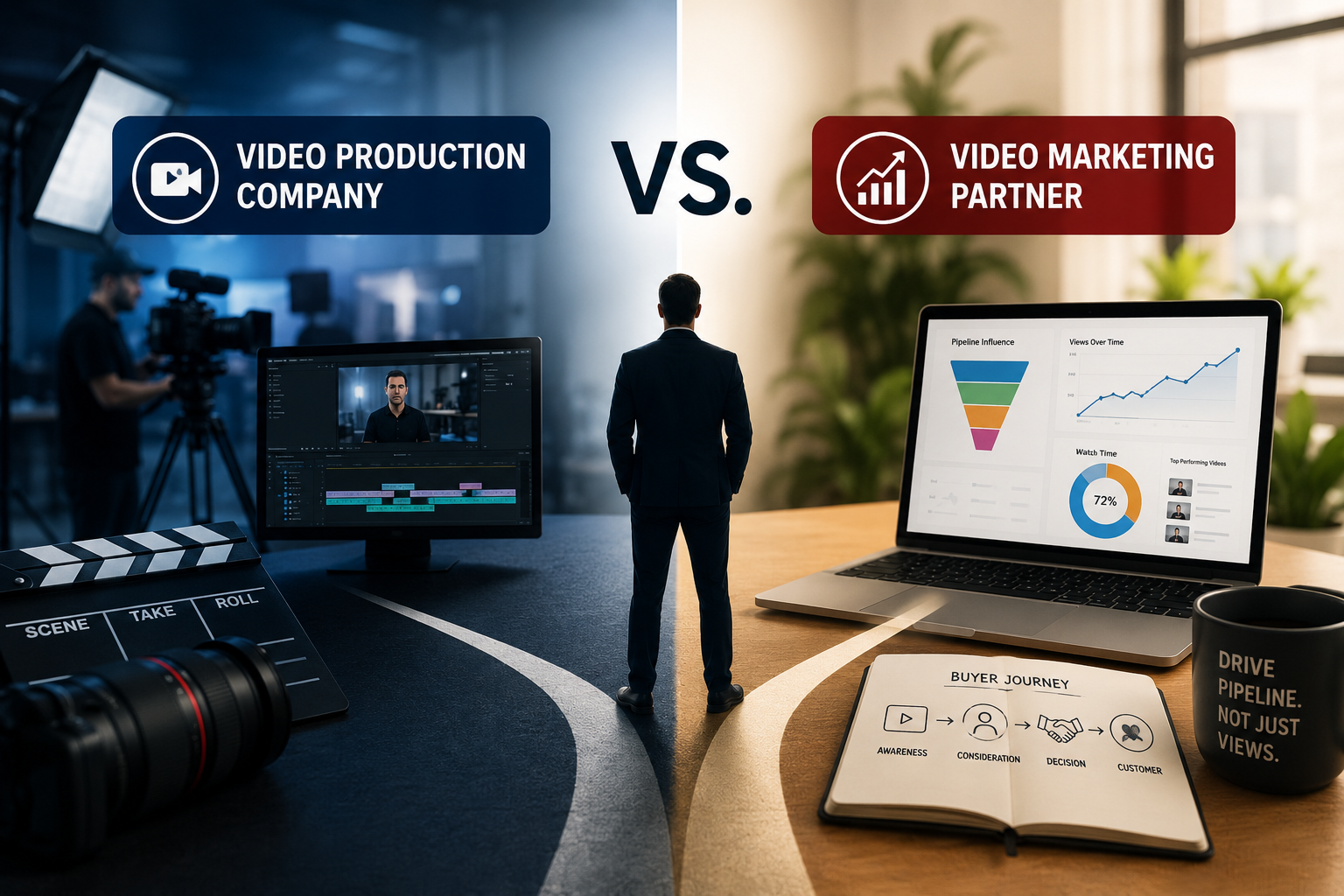
A production company delivers assets.
A video marketing partner builds systems that influence the pipeline.
This breaks down the difference and how to choose the right approach for your team.
The Real Problem: Great-Looking Video, Zero Business Impact
We have seen a common pattern when teams are looking to make B2B videos.
They look for a B2B video production company, review a few reels, choose a team that produces high-quality work, and commission a project. A brand video. A few customer stories. Maybe a product explainer.
Six months later, the outcome is predictable:
“It looks great. We just haven’t really used it.”
Clean video content is great but without showing proof, explanation, and trust, they can end up collecting dust.
Most B2B buyers rank vendors before talking to sales. That means your brand has to create familiarity and trust before your sales team ever enters the conversation.
95% of buyers end up choosing a vendor from their Day One shortlist, which means if you’re not shaping perception early, you’re not really in the deal at all.
Most videos aren't built for that reality.
It’s created as an asset, not as part of a buying journey.
The issue isn’t whether a video looks polished. It’s whether that video was built to support a buying journey, a channel strategy, and a revenue motion.
That’s why most video never shows up where it matters:
- Not in sales conversations
- Not in internal buying discussions
- Not in late-stage deal risk
And those internal dynamics matter more than most teams realize. Buying groups now average around 10 stakeholders, and 74% of those groups experience unhealthy conflict during the decision process.
Their video exists. It just doesn't participate in the buyer's journey. Too often, it's treated as content, living purely in the awareness stage, and not translating into a holistic strategy.
If you zoom out, this ties directly to the broader role of video in B2B marketing. Video isn’t just content. It’s how buyers build trust before they ever talk to you.
What does a Typical B2B Video Production Company Do?
Where production companies are genuinely useful
A production company executes in a defined environment.
You bring a defined project, and they deliver against it.
That typically includes editing footage you supply and limited creative direction.
This work If you already know what you need and where it fits, a production partner can be useful.
Where they usually stop (and why that hurts you)
Most production companies stop at delivery and don’t deliver a deeper market strategy or pre-production
They don’t typically:
- Map content to funnel stages
- Design for multi-channel distribution upfront
- Align with sales on how assets will be used
- Connect performance to pipeline metrics
- Iterate based on what influences deals
That gap creates a predictable outcome.
You usually get a polished asset, but:
- It’s hard to repurpose
- It doesn’t fit naturally into sales conversations
- No one owns distribution
- There’s no feedback loop
The work can be good. It’s just disconnected from how buyers actually make decisions.
Here’s the simplest test:
If your videos aren't showing up in your lead attribution, it’s not working.
Not because it looks bad. Because it wasn’t built for how deals move.
What Does a B2B Video Marketing Partner Look Like?
A video marketing partner starts in a completely different place.
Not with:
“What kind of video do you want?”
But with:
“Where is your pipeline getting stuck?”
Starts with revenue, not a shot list
The conversation shifts immediately.
Instead of formats, you’re talking about:
- Where deals slow down
- Which segments matter most
- What objections show up repeatedly
- How your GTM motion actually works
From there, video gets mapped to specific jobs across the business.
At the top of the funnel, it builds awareness and grows your audience. It helps your best people show up consistently, turning subject matter experts into recognizable voices in your category.
In the middle, it builds trust and sharpens your point of view. Thought leadership, customer stories, and product breakdowns help buyers understand how you think and why you are different.
Closer to revenue, it supports active deals. Video helps differentiate in competitive cycles, reinforces your positioning, and gives buyers the confidence to move forward.
It does not stop at the sale. Video supports expansion and upsell by continuing to educate customers and reinforce value over time.
Internally, it strengthens employee advocacy and helps attract and retain talent. The same content that builds trust with buyers often shapes how your company is perceived by future hires.
What you’re building is not a set of videos.
You’re building a layer of proof, explanation, and trust that shows up across the entire buying process.
Before sales conversations. During evaluation. Inside buying committees.
And that last part matters more than ever. Research shows over 40% of B2B deals stall due to internal misalignment within buying groups, which means your content needs to help buyers align internally, not just understand your product.
Decide Where It Lives Before You Make It
Distribution should be planned from the beginning; it is not something you can just figure out later.
LinkedIn video viewership is up 36% year over year, and 48.6% of marketers say short-form video delivers the highest ROI, which makes video harder to treat as optional in B2B distribution.
Your buyers are already consuming more video.
The question is whether your content shows up where decisions happen.
A strong partner designs every recording for multiple uses:
- Website conversion points
- Sales enablement
- LinkedIn and paid distribution
- Email and outbound sequences
- YouTube and search discovery
You should be thinking about how to make video content discoverable in AI-powered search, without it you miss a layer of visibility.
The best-performing video content gets watched and shared.
That’s when it stops being marketing content and starts influencing decisions.
Video Marketing Partners Builds a system, not a one-off project
This is the biggest shift.
From:
“We need a video”
To:
“We need a repeatable content system”
Something we have seen multiple times in the B2B space is teams operating episodically.
A few videos here. A campaign there. Then momentum drops.
A marketing partner builds a system:
- Recurring recording cadence
- Repeatable formats
- Standardized workflows
- Ongoing distribution
- Feedback tied to pipeline
This is what a broader B2B video marketing system actually looks like in practice.
Over time, that system compounds.
Not just more content. Better content that actually gets used and accelerates momentum in the buyer's journey.
Episodic Content vs. a Systemized B2B Video Engine
When all that teams do is launch a series and record a few videos it has a high probability that it will stall.
This process is too inefficient.
Each effort becomes a new project with no continuity.
The result:
- No compounding value
- No consistent presence
- No system
The problem isn’t that you’re creating video.
It’s that every piece starts from zero.
The greatest video strategies compound over time and keep a presence.
What a systemized engine looks like
A systemized approach is simple, but disciplined.
- One core format
- Recurring recording cadence
- Standardized workflows
- Clear distribution
- Ongoing feedback
Over time, this creates:
- A library tied to buyer questions
- Familiarity in your category
- Content that shows up in deals
How to evolve into a repeatable system
Start small.
- Choose one format tied to a business goal
- Anchor it to a GTM motion
- Build a repeatable workflow
- Assign ownership
- Measure pipeline influence
This is the same shift teams make when building a B2B content marketing strategy.
A reliable signal your system is working:
Prospects reference your content before you send it.
If You Want Video That Performs, Not Just Plays
Most marketers report positive ROI from video. Short-form video continues to lead in performance, and teams consistently see higher engagement when video is embedded on key pages.
In fact, platforms like Vidyard have shown that adding video to key pages can increase dwell time by up to 1.4x, reinforcing how video supports deeper engagement during evaluation. The breakdown videos on competitor product pages are not there for decoration. They are doing real work.
The real question is whether your video is built to work. Plenty of teams produce polished content. Very few have a system that gives that content a job across the funnel. That difference is what shows up in revenue.
If you want video that actually influences the pipeline, you don’t need more assets.
You need a system. One that maps every video investment to a specific job in your funnel and a measurable outcome.
If you want help building that system, book a call with the Sweet Fish team.
FAQs
What does a B2B video production company do?
They create video assets, focusing on execution rather than strategy or distribution.
What is a video marketing partner?
A partner connects video to the pipeline by designing, distributing, and optimizing content across the buyer journey.
Which is better: production company or marketing partner?
Production companies can be great for execution. Marketing partners are better for driving revenue impact.
How does video impact the pipeline?
Video builds trust early, supports evaluation, reduces risk, and helps sales influence buying committees.
How do you measure video success in B2B?
Focus on pipeline influence, deal velocity, and whether content is actually used in sales.
How many videos does a B2B company need?
Fewer than you think. What matters is coverage across key buyer questions and GTM motions.