

B2B marketers have more ways to reach an audience than ever.
You can publish an article on your website. Run a LinkedIn ad. Launch a video podcast. Earn a mention in an industry publication. Send a newsletter. Post a clip on YouTube. Get a customer to share it. Put paid spend behind the clip.
The channels multiply quickly.
But most of them still fit into three fundamental categories: paid, earned, and owned media.
Understanding the difference matters. More importantly, understanding how they work together can turn a collection of disconnected marketing activities into a system that compounds over time.
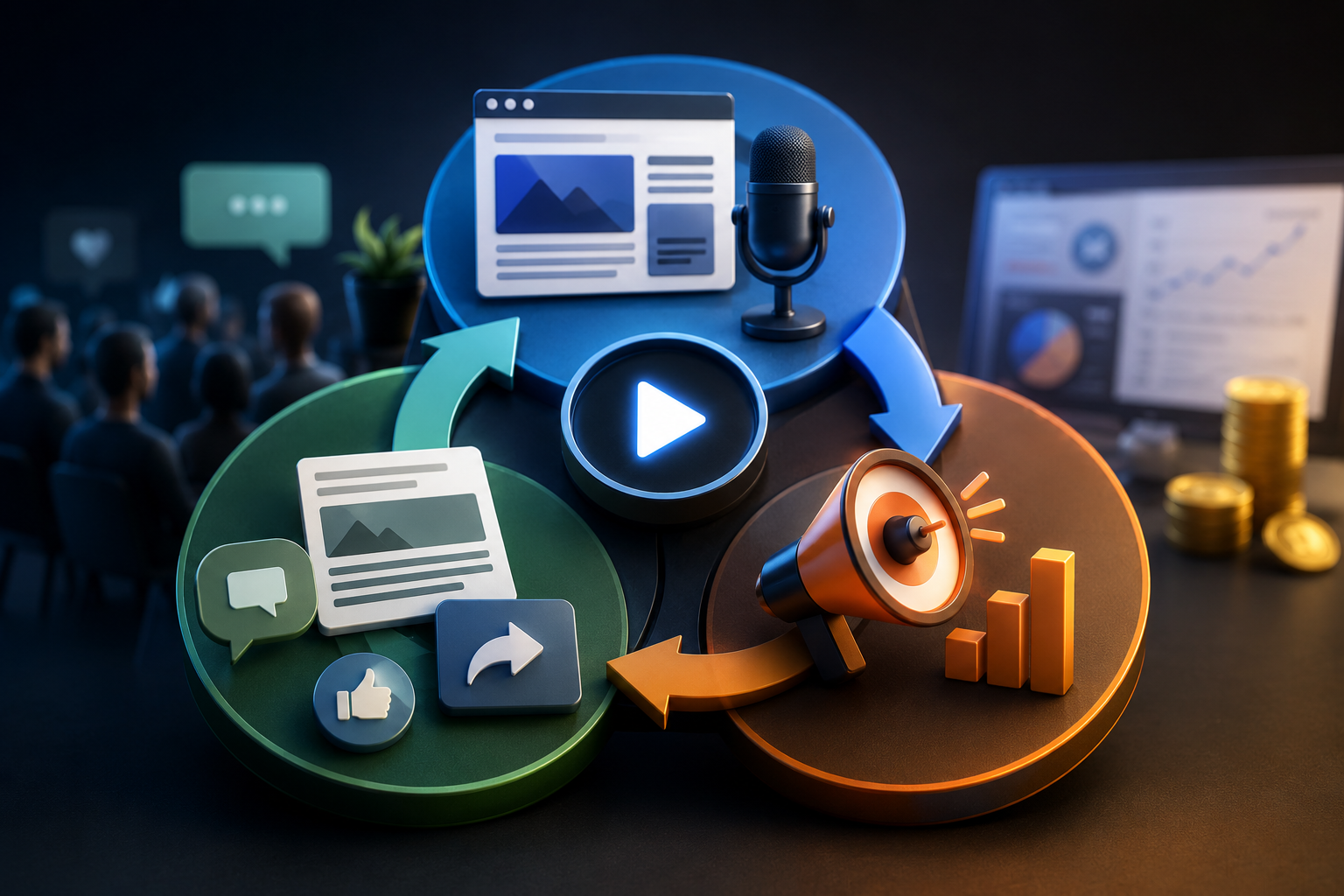
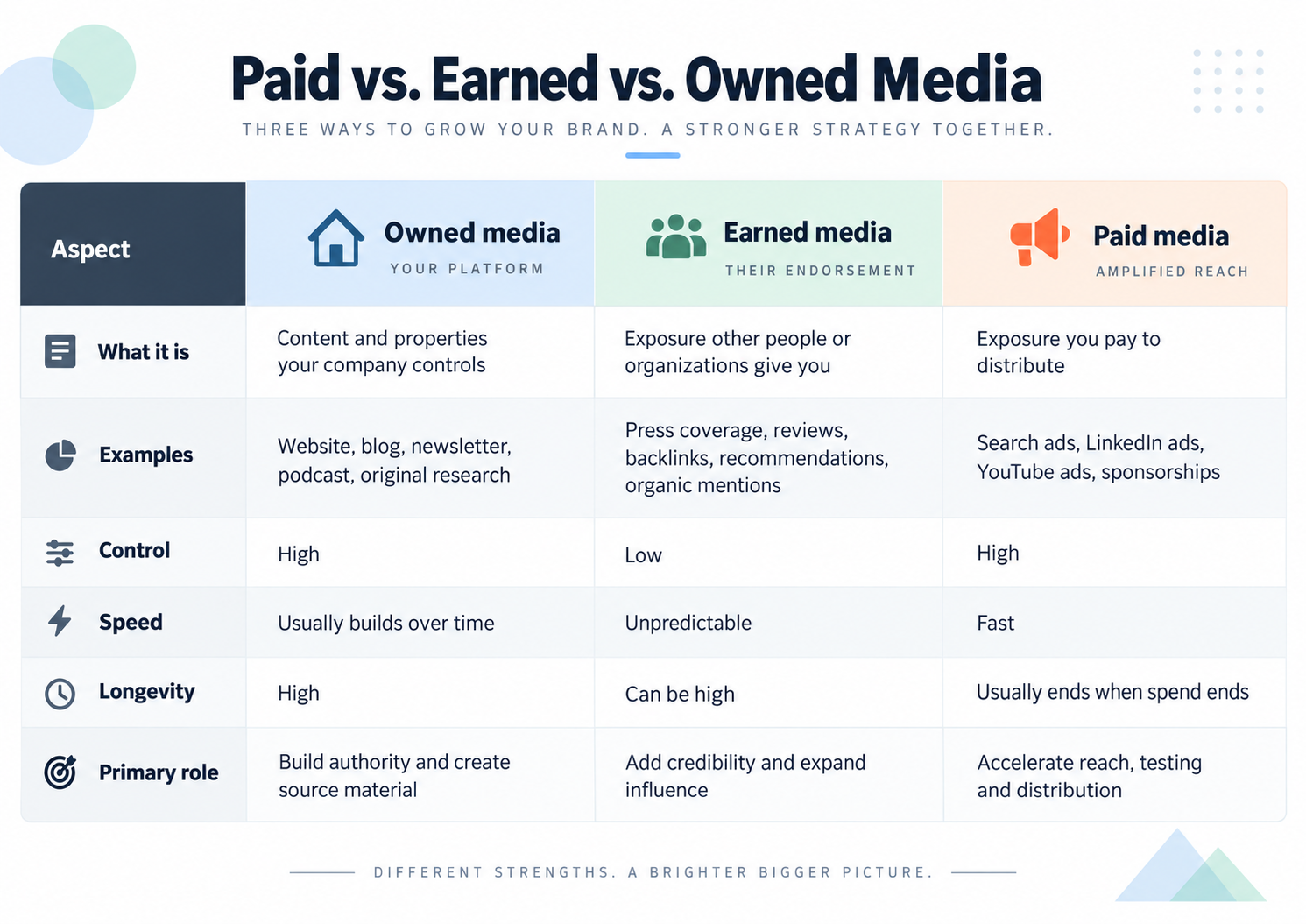
Paid media is exposure you pay for. Owned media is content and channels your company controls. Earned media is attention or coverage you receive from independent third parties without paying for that specific placement.
The strongest B2B strategies don't choose one over the others. They use owned media to establish expertise, paid media to accelerate distribution and learning, and earned media to add outside credibility.
Paid, earned, and owned media at a glance
Owned media
Earned media
Paid media
What it is
Content and properties your company controls
Exposure other people or organizations give you
Exposure you pay to distribute
Examples
Website, blog, newsletter, podcast, original research
Press coverage, reviews, backlinks, recommendations, organic mentions
Search ads, LinkedIn ads, YouTube ads, sponsorships
Control
High
Low
High
Speed
Usually builds over time
Unpredictable
Fast
Longevity
High
Can be high
Usually ends when spend ends
Primary role
Build authority and create source material
Add credibility and expand influence
Accelerate reach, testing and distribution
None of these works particularly well in a vacuum.
The opportunity is in how they connect.
What is owned media?
Owned media is content or a marketing property your company creates and controls.
Your website is owned media. So is your blog, newsletter, resource library, research, customer stories and other content you can publish, update and reuse without paying another company for access to the audience every time.
For B2B companies, common owned media examples include:
- Company websites
- Blogs and resource centers
- Video podcasts
- Email newsletters
- Original research
- Webinars
- Customer case studies
- Guides and ebooks
- Sales enablement content
- Proprietary tools and reports
Owned media matters because it gives you a place to build depth.
An ad might give someone a 30-second introduction to an idea. A LinkedIn post might give them 200 words. An owned resource can explain the entire argument, answer follow-up questions, establish expertise and direct someone toward the next step.
It also gives your best ideas somewhere permanent to live.
A B2B owned media example: Black Kite's Third Party podcast
Black Kite's Third Party podcast is a useful example of what owned media can look like when it becomes a system rather than a single content format.
The video podcast is the starting point, not the finished product.
One episode can become:
Video podcast episode → YouTube video → website episode page → written article → newsletter content → short clips → executive social posts → sales enablement
That changes the economics of content creation.
Instead of asking the team to independently develop an article, several social posts, a newsletter, a video and something for sales, the company starts with one substantive conversation and turns it into a portfolio of useful assets.
The long-form video captures the expertise.
The website page turns that expertise into something search engines, AI systems and buyers can more easily navigate in written form.
Shorter assets distribute the ideas.
Sales can reuse the content when the same questions come up in conversations with prospects.
And the original episode remains available as an evergreen source.
That's the real advantage of strong owned media: one idea can continue creating value long after the initial publish date.
The advantage of owned media
Owned media gives B2B companies several things other channels can't guarantee:
Control. You decide the subject, depth, format, positioning and CTA.
Longevity. A useful article, podcast episode or research report can continue earning attention months or years later.
Depth. You aren't restricted to the length of an ad or social post.
Reuse. One substantial asset can become dozens of smaller assets.
Compounding value. A growing body of useful content can strengthen your site's topical authority, sales resources and overall brand footprint over time.
But owned media has one obvious limitation:
Publishing something doesn't mean people will see it.
That's where distribution matters.
What is earned media?
Earned media is attention, coverage or advocacy your brand receives from a third party without paying for that specific placement.
It's somebody else deciding your company, content or ideas are worth talking about.
Examples of earned media in B2B include:
- Press coverage
- Industry publication mentions
- Analyst mentions
- Customer recommendations
- Organic reviews
- Podcast guest appearances
- Unpaid expert or creator mentions
- Organic backlinks
- Social shares
- Community discussions
- Citations of your company's research or data
- Customers recommending you to other buyers
Earned media is valuable because the message isn't coming entirely from you. You can publish on your website that your company is an expert in a category.
It's different when an industry publication references your research, a customer recommends you in a community, or another expert cites your company while explaining the topic.
That third-party validation can make the claim more credible.
What doesn't count as earned media?
The line gets blurry when money changes hands. A few examples make the distinction easier:
Your company publishes a research report on your website: owned media.
An industry journalist references that research in an article: earned media.
You pay a publication to run a sponsored article about the report: paid media.
A customer voluntarily shares the report with their LinkedIn audience: earned or shared media.
You pay an influencer to promote the report: paid media.
Earned media doesn't mean you have to sit around hoping somebody notices you. You can create conditions that make earning attention more likely. Strong original research gives journalists something worth citing. Interesting experts give podcast hosts someone worth interviewing. Useful resources give other websites something worth linking to. Remarkable customer results give customers something worth talking about.
You can't control the resulting coverage, but you can create better raw material for it.
What is paid media?
Paid media is distribution you purchase to put your message or content in front of a specific audience.
Common B2B paid media examples include:
- Google Search Ads
- LinkedIn Ads
- Meta Ads
- YouTube Ads
- Retargeting campaigns
- Sponsored newsletters
- Podcast sponsorships
- Sponsored content
- Paid creator partnerships
- Paid content distribution
- Event sponsorships
The obvious advantage of paid media is speed.
Organic distribution takes time. Earned media isn't guaranteed. Paid media allows you to decide which audience you want to reach and begin reaching that audience almost immediately.
But that doesn't mean paid media should exist as a separate machine from your organic content strategy.
In fact, one of the most valuable roles paid media can play is accelerating organic learning.
Paid media should accelerate organic growth—not replace it
A common mistake is treating organic content and paid media as two unrelated programs.
The content team publishes.
The performance team runs ads.
The two groups report different numbers.
Nobody asks what one system is teaching the other.
A stronger model uses paid distribution to help the company learn faster.
Suppose you publish a video around a problem your audience cares about.
Organically, it might take weeks to accumulate enough reach to understand whether:
- The topic resonates
- The hook is strong
- The right people are engaging
- A particular clip outperforms the others
- One message generates better comments
- Buyers care about one subtopic more than another
Paid media can compress that feedback loop.
You can put the content in front of the audience you actually want to reach, collect more signal, identify what gets attention and use those learnings to inform future content.
Then you repeat the process.
Organic content gives paid media better material to distribute. Paid media gives your content strategy faster audience feedback.
As you discover which topics, hooks, formats and messages consistently attract the right people, those insights should influence what you create next.
Paid media can also expose more relevant people to your brand, creating opportunities for those people to follow, subscribe, search for you, engage with future posts or share the content themselves.
But there's an important distinction:
Buying distribution doesn't automatically buy organic reach.
Paid and organic recommendation systems aren't interchangeable, and ad spend isn't a shortcut to organic authority.
The goal is bigger than that.
Paid should help you create a faster learning system.
Instead of spending money simply to generate impressions, you're spending money to:
Reach → learn → adapt → create better content → reach more of the right people.
Over time, the paid and organic programs should make each other smarter.
Paid vs. earned vs. owned media: what's the difference?
The easiest way to distinguish the three is to ask one question:
Who controls the distribution?
With owned media, you control the source.
With paid media, you pay another platform or publisher to distribute the message.
With earned media, somebody else chooses to distribute or talk about it.
That difference changes how each channel should be used.
What about shared media? Understanding the PESO model
Paid, earned and owned media is often called the POE model.
But modern social platforms made that framework more complicated.
If your company publishes a LinkedIn post, is that owned media?
You created the post and control your account. But you don't own LinkedIn, its audience or its distribution algorithm.
That's why another framework—PESO—adds a fourth category: shared media.
PESO stands for:
- Paid: distribution you purchase
- Earned: attention other people give you
- Shared: content distributed through social platforms, communities and networks
- Owned: properties and content your company directly controls
The model is useful because it acknowledges that your LinkedIn account and your website aren't the same thing.
You control what you publish on both.
But only one exists on a property you own.
This is also why B2B companies shouldn't build their entire content strategy on social reach.
Social platforms are incredibly useful for distribution and conversation. They simply shouldn't be the only place your best thinking lives.
If an idea matters, give it a permanent home too.
How paid, earned and owned media work together in B2B
The biggest mistake marketers make with these categories is treating them as separate strategies.
They shouldn't be.
A good B2B media system might look like this:
1. Owned media creates the source material
Your subject matter expert records a video podcast episode answering a question your buyers repeatedly ask.
The episode becomes the definitive version of the idea.
You publish it on YouTube and create an optimized page on your website containing the video, written explanation, key takeaways and related resources.
Now you have something substantial to distribute.
2. Shared media breaks the idea into smaller pieces
You turn the conversation into:
- LinkedIn posts
- Executive posts
- Short clips
- Graphics
- YouTube Shorts
- Newsletter sections
- Community discussions
Instead of asking your team to invent something new every morning, you're distributing pieces of a larger body of expertise.
3. Paid media accelerates reach and learning
The strongest clips or ideas get paid distribution.
Now you're exposing them to more of the audience you actually want.
The resulting performance gives you another layer of information:
Which topic got the strongest response?
Which opening line stopped people?
Which executive perspective created discussion?
Which audience segment engaged most?
That information feeds back into the editorial process.
4. Earned media adds validation
A guest shares the episode.
A customer sends it to a peer.
An industry publication cites your research.
A newsletter links to it.
Someone recommends the show in a community.
Now the idea is moving beyond channels you directly control.
5. The signals feed back into the next owned asset
The questions in the comments inform another episode.
The high-performing clip becomes a deeper article.
A customer response turns into a case study.
A frequently referenced point becomes a sales resource.
The media system begins compounding.
Create → distribute → learn → validate → create again.
That's much more powerful than thinking: “We published three blogs, five LinkedIn posts and a podcast this month.”
Content volume isn't the system. The connections between the content are.
How Black Kite turns one podcast into an owned media system
Black Kite's Third Party podcast is a good example because the company doesn't treat the podcast as an isolated audio show.
The show is an ongoing source of ideas around third-party cyber risk.
Each substantial conversation gives the marketing team material that can live across multiple surfaces.
The long-form episode
The full video creates depth.
Instead of summarizing a complicated issue in a few sentences, Black Kite's experts have room to explain what they believe, disagree, work through nuances and give practitioners something genuinely useful.
That's particularly valuable in technical B2B categories, where buyers often need more than a surface-level explanation.
The YouTube channel
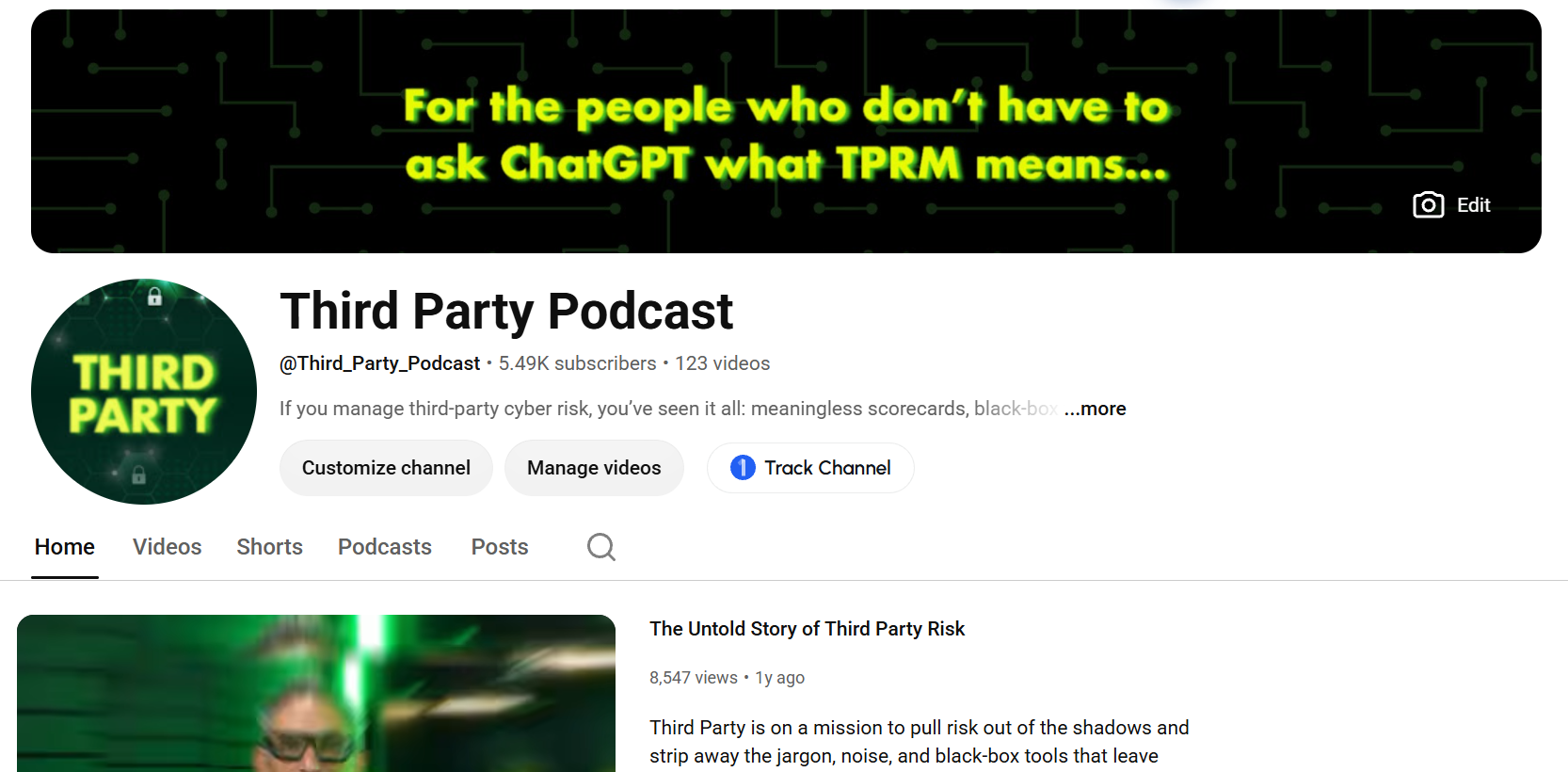
The video version makes those conversations discoverable and consumable in another environment.
It also gives each subject a visual, searchable asset that can continue attracting viewers beyond the initial release.
The website
Episodes aren't left exclusively on YouTube.
They also become individual resources on Black Kite's website.
That's an important distinction.
A video hosted only on somebody else's platform is useful.
A video supported by an owned page gives the company much more to work with: written context, search visibility, internal linking opportunities, related resources and a clear path deeper into the brand.
Written content
The episode can also become an article rather than forcing the company to invent an entirely unrelated blog topic. Here’s an example from the same client, Black Kite.
That written version doesn't need to be a verbatim transcript.
It can extract the most useful ideas, organize the argument, answer the important questions and make the expertise easier to scan.
Now the same expert conversation exists in both video and text.
Newsletter and social distribution
The strongest ideas can then move into the newsletter, short-form clips and executive posts.
Each format does a different job.
The episode delivers depth.
The article creates a structured written resource.
The newsletter reaches existing subscribers.
Social creates distribution and conversation.
Clips isolate specific hooks or insights.
Sales enablement
Then comes an often-overlooked benefit.
Marketing doesn't need to measure the value of the episode only by how many people watched it the week it was published.
The content can also answer questions sales is already hearing.
When a buyer asks about a problem the podcast has covered, the team has a useful expert resource to send them.
Now the content isn't just “marketing content.”
It's organizational knowledge packaged in a way the rest of the company can use.
That's what strong owned media should become.
Where AI search fits into paid, earned and owned media
Search is changing, but the underlying need for useful source material hasn't disappeared.
If anything, the rise of AI search makes the relationship between owned and earned media more important.
Owned media gives your company somewhere to establish what it knows
Your website can clearly explain:
- What your company does
- What problems you solve
- What categories you're associated with
- What your experts believe
- How your process works
- What results you've created
- How you answer important buyer questions
That can include service pages, articles, research, customer stories, video pages, transcripts and FAQs.
The clearer and more complete that body of information is, the easier it is for both people and machines to understand what your company is actually about.
Earned media creates independent evidence about your brand
Your website shouldn't be the only place saying you're knowledgeable about a topic.
Third-party articles, podcast appearances, customer reviews, mentions, links and citations create additional evidence across the web.
Search engines and AI systems can encounter that information independently of your own claims.
That makes earned media more than a PR exercise.
It expands the ecosystem of information surrounding your brand.
Paid media accelerates discovery—but it doesn't manufacture authority
You can't simply buy your way into being a trusted source in AI search.
But paid media can get your best ideas in front of more of the right people.
That increases your opportunity to earn:
- Engagement
- Followers
- Subscribers
- Brand searches
- Shares
- Conversations
- Mentions
- Links
- Future organic discovery
The better way to think about the system is:
Owned creates the idea.
Paid accelerates its distribution.
Earned validates and expands it.
Search and AI discovery can compound the footprint.
How to build a paid, earned and owned media strategy
You don't need three separate strategies.
You need one strategy that gives each media type a clear role.
Step 1: Start with the audience and business problem
Don't begin with:
“We need a podcast.”
“We need more LinkedIn content.”
“We need PR.”
Begin with the people you're trying to reach and the questions, problems or categories you need to become associated with.
That gives the rest of the media system a purpose.
Step 2: Choose your primary owned content engine
You need somewhere to consistently develop substantial ideas.
That might be:
- A video podcast
- An original research program
- A newsletter
- A webinar series
- An editorial resource center
- A combination of formats
For many B2B companies, video works particularly well because one expert conversation can feed several other formats.
The important thing isn't choosing the trendiest format.
It's creating a repeatable source of expertise.
Step 3: Create for reuse from the beginning
Don't finish an episode and then ask:
“What should we do with this?”
Decide before recording.
What questions is this answering?
What article can come from it?
Which clips should we look for?
Which sales conversations could it support?
What newsletter angle does it create?
What related page should it link to?
Distribution shouldn't be the last step of content creation. It should influence how the content gets made.
Step 4: Use organic distribution to establish a baseline
Publish the ideas across relevant channels and see what earns attention naturally.
Look for useful signals:
- Watch time
- Comments
- Shares
- Clicks
- Saves
- Replies
- Search impressions
- Subscriber growth
- Sales feedback
Don't assume one low-performing post means the entire topic is bad.
But use your organic program as an ongoing source of qualitative and quantitative audience feedback.
Step 5: Use paid media to accelerate the learning loop
Put spend behind promising creative and strategic messages.
Paid distribution can help you gather enough signal to make decisions faster.
Use those results to answer questions like:
- Which message attracts the right audience?
- Which topics create deeper engagement?
- Which hook gets someone to stop?
- Which format works best?
- Which expert should we feature more often?
- Which audience segment responds?
- Which themes deserve deeper content?
Then feed those answers back into the content program.
Paid performance shouldn't live only in an advertising dashboard.
It should influence editorial strategy.
Step 6: Build earned media opportunities into the work
Ask why somebody else would share or cite the content.
Does it contain original data?
A strong opinion?
A useful framework?
A credible expert?
A surprising result?
A valuable guest?
A resource worth bookmarking?
Earned media is much easier to pursue when the underlying content deserves to travel.
Step 7: Connect the pieces
Link articles to relevant service pages.
Embed video where it improves the written resource.
Reference research from related posts.
Include useful content in sales follow-ups.
Turn customer questions into future episodes.
Use winning organic ideas in paid.
Use paid learnings to create better organic content.
Turn third-party recognition into proof across your owned channels.
That's how the pieces begin working as a system instead of a content calendar.
How do you measure paid, earned and owned media?
Each type of media plays a different role, so measuring all three by the same KPI doesn't make much sense.
Owned media metrics
Depending on the format, look at:
- Organic search visibility
- Engaged visitors
- Video views and watch time
- Email subscribers
- Newsletter engagement
- Return visitors
- Content-assisted conversions
- Demo or contact requests
- Sales usage
- Influenced pipeline
Earned media metrics
Look at:
- Brand mentions
- Referral traffic
- Backlinks
- Customer reviews
- Organic social mentions
- Shares
- Publication mentions
- Share of voice
- Branded search trends
Some of the most valuable earned activity will also be qualitative.
A recommendation from the exact right industry expert can matter more than thousands of generic social impressions.
Paid media metrics
Depending on the objective, that might include:
- Reach
- Frequency
- CPM
- Video completion
- Click-through rate
- CPC
- Conversion rate
- Cost per lead
- Cost per qualified opportunity
- Customer acquisition cost
- Influenced pipeline
But don't stop at campaign metrics.
If you're using paid to accelerate an organic content system, ask another set of questions:
What did we learn?
Which messages performed?
Which topics earned engagement?
Which creative attracted the right people?
What should the organic team create next?
What should we stop making?
What deserves more investment?
The value of paid media isn't limited to the conversions that happen inside the campaign.
It can also make the rest of the marketing system smarter.
Common paid, earned and owned media mistakes
1. Building your entire audience on rented platforms
LinkedIn, YouTube and other platforms are valuable distribution channels.
But algorithms change.
Reach changes.
Features disappear.
Your best content should also contribute to assets you control.
2. Using paid media to compensate for weak content
More distribution won't fix an idea nobody cares about.
It will just help you discover that faster—and more expensively.
Paid works best when there's already something worth amplifying.
3. Publishing owned content without a distribution strategy
“Publish and pray” isn't a growth strategy.
Decide how people will find the content before you create it.
4. Treating sponsored coverage as earned media
If you paid for the placement, it's paid media.
That doesn't make it bad.
It just means it should be measured and evaluated differently.
5. Assuming earned media has to happen accidentally
You can't force independent coverage.
But you can deliberately create research, expertise, customer stories and resources that make coverage more likely.
6. Measuring every channel the same way
A podcast episode doesn't need to produce leads the same way a high-intent Google Search campaign does.
Understand the job of the asset before deciding whether it worked.
7. Running separate paid, organic and content strategies
If your paid team never speaks to your content team, you're leaving valuable audience intelligence on the table.
The channels should continuously teach each other.
Frequently asked questions about paid, earned and owned media
What is the difference between paid, earned and owned media?
Paid media is exposure a company purchases. Owned media is content or a property the company creates and controls. Earned media is attention or coverage a third party voluntarily gives the company.
For example, an article on your company website is owned media. A LinkedIn ad promoting that article is paid media. An industry publication citing the article is earned media.
What are examples of paid, earned and owned media?
Paid media examples include Google Ads, LinkedIn Ads, YouTube Ads, sponsorships and promoted content.
Owned media examples include your website, blog, newsletter, podcast, research and customer stories.
Earned media examples include media coverage, organic backlinks, reviews, customer recommendations, social shares and third-party mentions.
Is SEO paid, earned or owned media?
SEO doesn't fit perfectly into a single category.
The content and website you're optimizing are typically owned media.
The organic search visibility you earn as a result can be thought of as earned distribution, since you don't pay the search engine for the ranking.
Paid search advertising is paid media.
Is social media owned or earned media?
A company's social account is sometimes categorized as owned media because the company controls what it publishes.
However, the company doesn't own the platform or control its distribution.
For that reason, the PESO model categorizes social platforms as shared media, which is often a more accurate description.
Is YouTube owned media?
The videos your company creates are your content, but YouTube itself is a third-party platform.
It's useful to think of YouTube as a distribution platform for content you own rather than a property you completely control.
That's also why publishing important video content alongside useful resources on your own website can strengthen the overall content system.
Are influencer partnerships paid or earned media?
If a company pays a creator or influencer for the promotion, it is paid media.
If an expert independently chooses to recommend, review or mention the company without compensation, that exposure is generally earned media.
Are backlinks earned media?
Organic backlinks are usually considered earned media because another website has independently chosen to reference or link to your content.
Links purchased as part of a sponsorship or paid placement are not earned media.
Is PR earned media?
Traditional editorial coverage generated through PR is typically earned media.
However, PR activity can also lead to owned or paid assets.
A press release published on your own newsroom is owned media. A sponsored placement is paid media. An independent journalist writing about the announcement is earned media.
What is the PESO model?
The PESO model divides media into four categories:
Paid, Earned, Shared and Owned.
It expands the traditional paid-earned-owned framework by separating social networks and community distribution into a distinct “shared” category.
Which type of media should B2B companies prioritize?
B2B companies shouldn't rely entirely on one type of media.
Owned media provides the foundation because it captures the company's expertise in assets it can continue using. Paid media can accelerate distribution and audience learning. Earned media adds third-party validation and expands the brand's footprint beyond the channels it controls.
The strongest strategy connects all three.
How do paid, earned and owned media work together?
A company can create an expert-led piece of owned content, distribute pieces of it organically, use paid media to reach more of the right audience and learn which messages resonate, then earn mentions, links, shares or recommendations from other people.
Those signals can then inform the company's next piece of owned content.
The result is a continuous cycle:
Create → distribute → learn → validate → compound.
Your media shouldn't operate in silos
Paid, earned and owned media aren't three boxes to check on a marketing plan.
They're parts of the same system.
Your owned media gives you something worth distributing.
Paid media helps you reach more of the right people and learn faster.
Earned media gives your ideas credibility outside the channels you control.
And every signal should help you create something better the next time around.
That's especially important for B2B teams with limited resources.
You don't need to create more disconnected content.
You need to get more value out of the expertise you already have.
That's why we believe a video podcast can be such a powerful center of a B2B content system. One great conversation can become the long-form video, the article, the newsletter, the short-form content, the executive thought leadership, the paid creative and the sales resource.
Instead of feeding an endless content calendar, you're building a media engine.
Sweet Fish helps B2B marketing teams build video podcasts designed to do exactly that—from strategy and production through distribution and growth.