

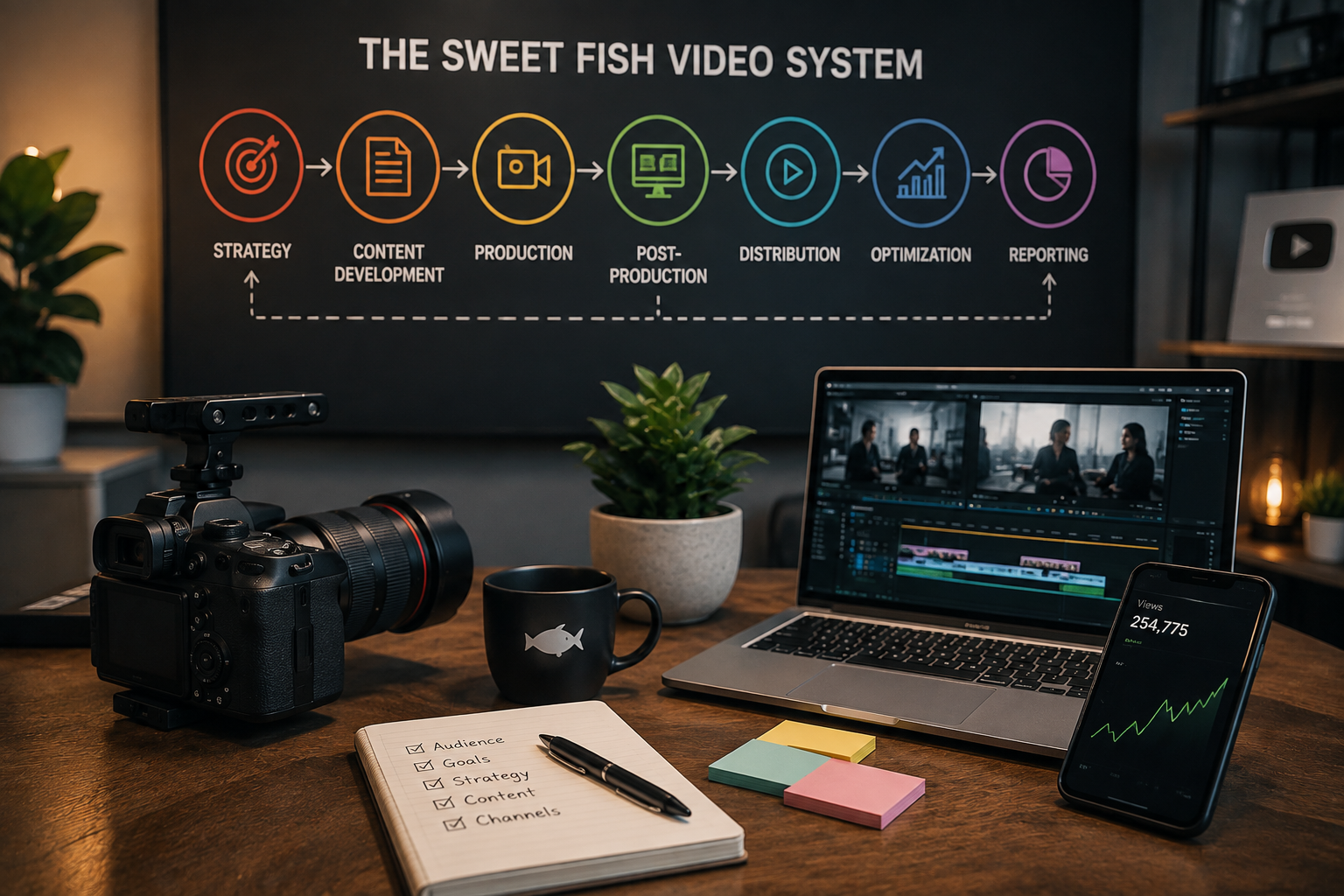
Sweet Fish Media uses a repeatable methodology to help B2B marketing teams plan, produce, distribute, measure, and improve video content.
The system moves through seven core stages:
Strategy → Content Development → Production → Post-Production → Distribution → Optimization → Reporting → back into Strategy
Every client moves through that same core system, but the strategy, creative, production model, and deliverables are customized around the business goal, audience, channels, and type of video being created.
A video podcast shouldn’t be built the same way as a testimonial program. A paid video campaign needs a different strategy than an executive thought leadership series. An event capture plan has different production needs than a recurring YouTube show.
The system gives us a repeatable way to make those decisions using data, watch behavior, and analytics from your own audience and niche.
And because the process loops back on itself, every round of content gives us more information about what your audience actually responds to.
Sweet Fish has worked with 450+ B2B brands, produced 10,000+ videos, and generated millions of views across client channels and campaigns.
The Sweet Fish Video System starts before anyone hits record
Video production is only one part of the work.
Before we decide what to shoot, how many cameras we need, or what the set should look like, we need to understand what the video is supposed to accomplish.
That means looking at the business goal, the audience, the content environment, and the channels where your buyers are actually spending time.
The cameras come later.
1. Strategy: Start with the audience and the business goal
Every Sweet Fish engagement starts with strategy.
And by strategy, we don’t just mean deciding that you want to create a podcast, shoot a testimonial, or film an event.
We want to understand the job the video needs to do.
A company trying to build brand awareness needs a very different video strategy from a company trying to drive booked calls. A team trying to establish an executive as a category expert may need a completely different content mix from a company launching a paid campaign.
So the first step is getting clear on the goal.
That can include:
- brand awareness
- audience growth
- executive thought leadership
- lead generation
- pipeline support
- sales enablement
- customer proof
- event amplification
- paid campaign performance
- YouTube growth
- category authority
Once we understand the goal, we go deep on the audience.
We want to know your audience really well
Your brand video should always start with your audience. Our in-house video marketing experts are here to help you be your audience’s biggest advocate.
Who are you trying to reach?
What do they care about?
What are they searching for?
What are they already watching?
What kinds of ideas get their attention?
And where do they actually live online?
For some audiences, LinkedIn may be the most important channel. Others may spend more time actively searching on YouTube. Some respond well to short-form POV content, while others are more likely to sit through a 30-minute expert conversation.
We look at the ICP, search behavior, content consumption, channel behavior, and the broader environment of content your audience is already engaging with.
That gives us a much stronger starting point than simply saying, “Let’s make some videos.”
We use search and audience data to shape the plan
The strongest content ideas usually live at the intersection of three things:
- what your business wants to talk about
- what your audience actually cares about
- what people are already searching for, watching, or engaging with
Sweet Fish uses search and audience data to help identify those overlaps.
That may influence:
- the topics we recommend
- the content formats we choose
- the channels we prioritize
- the length of the videos
- the creative direction
- the distribution plan
- the amount of paid support
- the types of assets we create from each production
The result is a video strategy built around the actual marketing goal.
The deliverables come from the strategy
We don’t start every engagement with a fixed menu of outputs.
One brand may need two long-form videos and a handful of short-form clips every month.
Another may need 30 pieces of social content, paid ad variations, and no long-form video at all.
Another may need a customer testimonial, a full case study, sales enablement clips, and paid creative from the same interview.
The right output depends on the audience, the goal, and where the content needs to work.
That’s why the strategy comes first.
2. Content development: Turn the strategy into something we can actually make
Once we know what we’re trying to accomplish, we turn the strategy into a production-ready plan.
This is where the ideas get specific.
Depending on the project, Sweet Fish may develop:
- show concepts
- campaign concepts
- storyboards
- scripts
- episode outlines
- interview briefs
- topic briefs
- hooks
- cold opens
- CTAs
- recurring content formats
- content calendars
- guest plans
- visual direction
- set concepts
- asset maps
If we need to help source guests, we can do that.
If a campaign calls for a voice actor, UGC creator, or another type of talent, we can source them too.
The goal is to make sure that when production day arrives, everyone knows what we’re capturing, why we’re capturing it, and where that footage is going afterward.
Different video types require different planning
A video podcast might need:
- show positioning
- recurring episode formats
- topic planning
- guest preparation
- long-form episode structure
- YouTube packaging
- social cutdown planning
A paid video campaign may need:
- creative concepts
- several hooks
- multiple openings
- scripts
- storyboards
- CTA variations
- several versions built for testing
A customer testimonial might need:
- story development
- interview questions
- proof points
- the full case study narrative
- shorter clips for ads, sales, and social
We build those decisions before production so the footage supports the broader strategy from the beginning.
Sweet Fish helped Holt Law create strategic video content to support sales, trust, and traffic.
3. Production: Build the right environment and capture what we need
Once the strategy and content plan are locked in, Sweet Fish handles production.
That can happen in our Sweet Fish Studios in the Orlando area, at your office, inside your own studio, at an event, at a customer location, or wherever the content needs to be captured.
Our production team handles:
- crew
- cameras
- lighting
- microphones
- audio
- equipment
- set design
- production logistics
- directing talent
- shot planning
- on-site coordination
If you already have your own production gear, we can work with that too. In most cases, though, Sweet Fish provides what’s needed for the shoot.
Every production gets its own visual identity
We don’t want every Sweet Fish client to look like a Sweet Fish client.
We want them to look like themselves.
For studio-based or recurring productions, that may mean designing a custom set or visual environment around the brand.
For on-location shoots, it may mean making the most of the client’s office, event environment, or existing studio.
The visual direction should support the brand, the content format, and the audience.
Even when we’re producing a lot of video across a lot of companies, each client should still have a recognizable look. And out set design pros ensure it.
We make the people on camera comfortable too
A good production setup matters.
So does the person sitting in front of the camera.
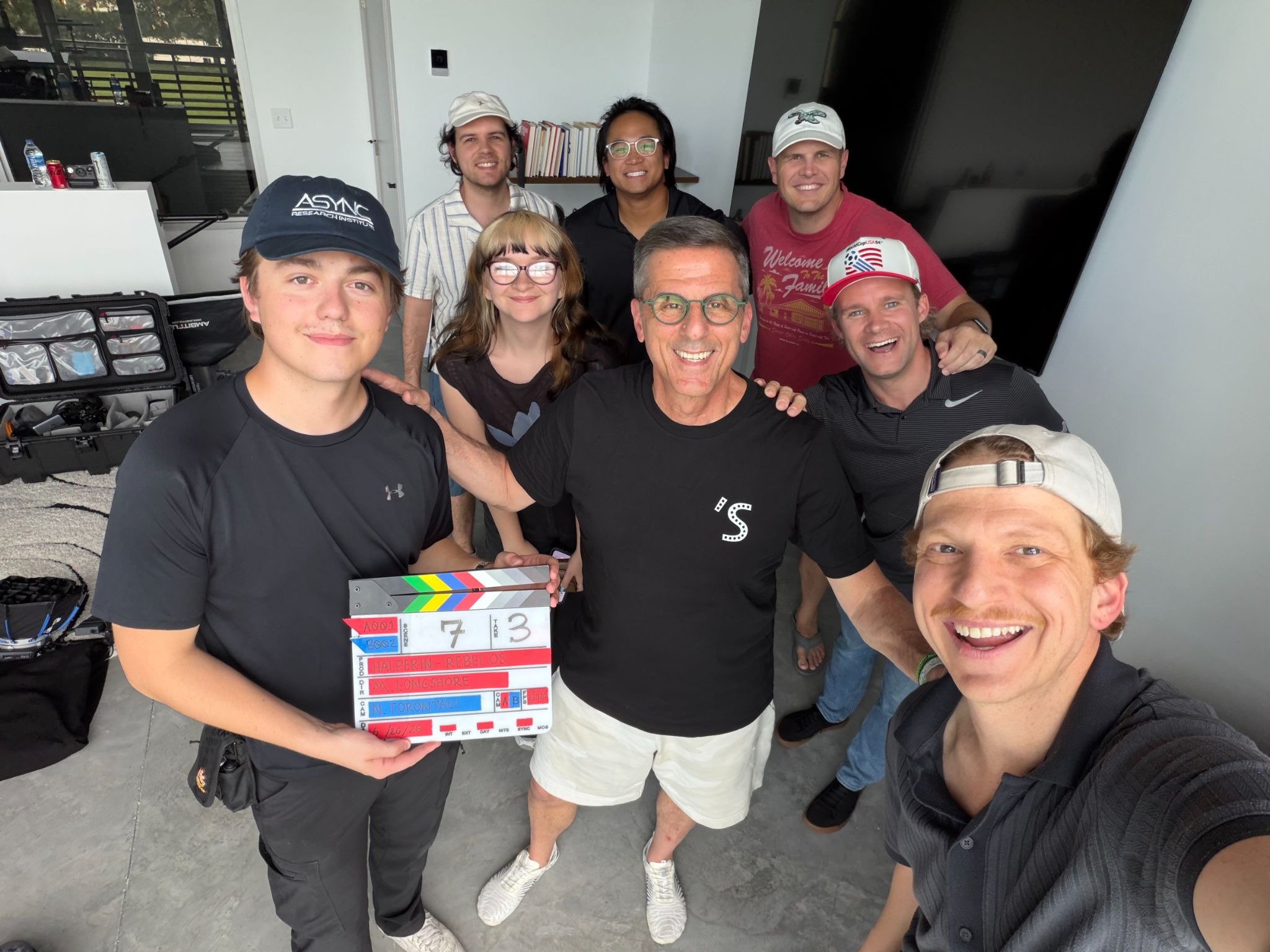
Our on-site team typically includes a production director and videographer, with additional crew depending on the shoot.
They’re there to make sure the production runs smoothly, the right content gets captured, and the people on camera feel prepared.
That can mean helping an executive through an interview, making sure a customer feels comfortable telling their story, or keeping a long recording day moving so nobody feels like they’ve been trapped under studio lights for eight hours.
We handle the production details so your team can focus on the actual conversation.
4. Post-production: Turn the footage into content built for its destination
Once we have the footage, our in-house post-production team turns it into the assets we planned.
That can include:
- long-form video editing
- audio editing
- short-form cutdowns
- color correction
- sound mixing
- motion graphics
- captions
- trailers
- hooks
- cold opens
- CTAs
- thumbnails
- titles
- descriptions
- platform-specific versions
- revision cycles
The important part is that these decisions connect back to the strategy.
A LinkedIn short should be edited differently from a YouTube episode.
A paid ad needs a different opening than a customer case study.
A sales enablement clip may need to get to the proof point much faster than a piece of long-form thought leadership.
The footage may come from the same production, but every asset has a different job.
One production can feed a much bigger content mix
A single recording session may create:
- full-length YouTube videos
- podcast episodes
- social shorts
- executive POV clips
- paid ad creative
- customer proof
- sales enablement clips
- trailers
- website video
- ABM assets
That’s why we think about the output before production.
If we already know we want six different kinds of content from the footage, we can capture and structure the production accordingly.
That makes the shoot much more useful to the marketing team.
For most clients, months of video is captured in a 1-2 day recording session. We often find that quarterly recording dates help fuel marketing efforts and keep teams on track without burning out.
5. Distribution: Make sure the video actually reaches someone
Once the content is finished, we can also help get it in front of the right audience.
Sweet Fish supports video distribution across organic channels, YouTube, paid media, sales, and broader marketing campaigns.
YouTube strategy and distribution
For YouTube, that can include:
- publishing
- titles
- thumbnails
- descriptions
- channel strategy
- search optimization
- playlists
- content packaging
- audience growth strategy
- ongoing performance analysis
We want the content to have the best possible chance of earning the click and holding attention once the viewer gets there.
That’s why titles, thumbnails, hooks, and topic selection are part of the strategy, not last-minute upload tasks.
Organic social distribution
We also help distribute video across platforms like:
- YouTube Shorts
- other relevant social channels
The exact platform mix depends on the audience.
We plan the content around where those buyers are most likely to see and engage with it.
Paid distribution
For some clients, organic reach is only part of the plan.
Sweet Fish can also manage paid media strategy and execution.
That can include:
- paid distribution strategy
- creative development
- ad variations
- audience targeting
- campaign setup
- campaign management
- performance monitoring
- creative iteration
Depending on the strategy, that may include platforms like LinkedIn, Meta, YouTube, or other paid channels.
This gives us another lever for reaching the right audience instead of relying entirely on the algorithm to figure it out.
Video can support the rest of your marketing too
Distribution also goes beyond social and YouTube.
The same footage can support:
- websites
- landing pages
- ABM campaigns
- sales follow-up
- sales enablement
- customer nurture
- employee distribution
- guest amplification
- paid campaigns
The point of the video determines where it should go.
Black Kite’s channel Third Party grew to 4,000+ subscribers in a highly niche vertical.
6. Optimization: Every video teaches us something about the next one
For ongoing Sweet Fish engagements, publishing isn’t the end of the process.
We keep watching what happens.
Depending on the channel and goal, we may monitor:
- click-through rate
- average percentage viewed
- audience retention
- watch time
- impressions
- reach
- engagement
- subscriber growth
- cost per view
- conversion rate
- leads
- booked calls
- pipeline influence
The important thing is that every video doesn’t get judged by the same metric.
A video designed to build executive awareness may be judged primarily on reach, engagement, and audience growth.
A YouTube show may depend more heavily on CTR, average percentage viewed, watch time, and subscribers.
A paid campaign may be judged on cost per view, conversions, booked calls, or another downstream action.
A sales enablement asset may be evaluated based on how sales is actually using it.
The goal determines the metric.
What do we optimize?
Pretty much anything that affects performance.
That can include:
- titles
- thumbnails
- hooks
- cold opens
- CTAs
- topics
- formats
- episode structure
- video length
- creative angles
- paid targeting
- distribution
- future content plans
If a thumbnail isn’t earning clicks, we can change it.
If the title isn’t working, we can test another approach.
If viewers are dropping off in the first 20 seconds, we can look at the cold open.
If one type of topic consistently outperforms another, that should influence what we plan next.
The optimization goes beyond fixing existing videos. The bigger value is what we learn for the next production.
7. Reporting: Show what happened, what we learned, and what changes next
You should be able to understand how your content is performing and why we’re making the creative and strategic decisions we’re making.
That’s where reporting comes in.
Sweet Fish provides ongoing performance visibility so clients can see how the content is working across the channels that matter.
That can include:
- performance updates
- channel metrics
- audience growth
- content performance
- paid campaign results
- creative learnings
- strategic recommendations
But reporting becomes much more useful when it turns into a conversation.
Biweekly editorial meetings
For ongoing clients, biweekly editorial meetings give us a regular place to look at performance and turn those learnings into creative decisions.
We may talk through:
- what performed well
- what underperformed
- audience behavior
- topics
- titles
- thumbnails
- upcoming episodes
- new creative ideas
- distribution
- paid performance
- what we want to test next
That keeps performance data connected to the content plan.
Quarterly business reviews
QBRs give us a chance to zoom out.
Rather than looking at individual videos, we can evaluate:
- overall channel performance
- audience growth
- content trends
- campaign results
- business impact
- strategic priorities
- what we should change in the next quarter
The goal is to make sure the video program is still aligned with the larger business objective.
Reporting closes the loop
This is where the methodology comes back around.
We started with a hypothesis about the audience, channels, creative, and distribution.
Now we have real performance data.
That information feeds into the next round of strategy.
The Sweet Fish Video System is a loop
The Sweet Fish Video System can be visualized like this:
Strategy → Content Development → Production → Post-Production → Distribution → Optimization → Reporting ↺
The initial strategy phase is usually the deepest.
That’s where we spend the most time learning the audience, business goals, market, channels, and content environment.
But strategy doesn’t stop after kickoff.
Once content is live, we start collecting real information about what your audience does.
That might tell us:
- which topics earn clicks
- which thumbnails perform best
- where people stop watching
- which formats get shared
- which channels generate reach
- which videos convert
- which creative angles resonate
- which campaigns deserve more investment
Those learnings influence what we create next.
Every time we publish, we learn something.
Over time, the video program gets smarter because we’re working from an expanding set of real audience signals rather than repeatedly starting from scratch.
That feedback loop is one of the most important parts of the Sweet Fish methodology.
How the Sweet Fish methodology changes based on the type of video
The underlying Sweet Fish Video System stays consistent, but the actual execution changes depending on the kind of content we’re creating.
Video podcasts and shows
For a video podcast, the system might look like:
Audience and search research → show strategy → topic planning → recording → full episodes + shorts → YouTube and social distribution → paid promotion → performance analysis → next episode strategy
We use search and audience data to shape the show, then monitor metrics like CTR, average percentage viewed, retention, watch time, and subscriber growth to keep improving it.
Video ads
For paid video, the process may look more like:
Audience + campaign goal → creative concepts → scripts/storyboards → production → multiple ad variations → paid distribution → performance analysis → creative iteration
Here, the biggest learnings may come from:
- hooks
- creative angles
- watch behavior
- CTR
- cost per view
- conversions
- booked calls
Those results tell us what to create next.
Customer testimonials
For customer proof, we might move through:
Story opportunity → interview strategy → production → full customer story + proof clips → website/social/sales/paid distribution
We plan the interview around the places the story needs to show up so one customer conversation can support multiple parts of the buyer journey.
Event capture
For events, the process could be:
Event goals → content plan → production logistics → interviews/panels/event footage → post-production → social/YouTube/sales distribution
Events give companies a rare opportunity to capture executives, customers, partners, and industry voices while everyone is already together.
We build the plan around getting as much useful content from that moment as possible.
Executive thought leadership
For executive content, the system may look like:
Audience + topic research → executive briefing → batch production → long-form and short-form assets → LinkedIn/YouTube distribution → engagement analysis → next content plan
The goal is to make it easier for executives to consistently share useful ideas without asking them to become full-time content creators.
What is it like to work with Sweet Fish Media?
Sweet Fish is designed to function as an extension of a B2B marketing team.
That means you’re working with more than a production crew.
Depending on the engagement, your Sweet Fish team may include:
- marketing strategists
- producers
- production directors
- videographers
- editors
- designers
- YouTube strategists
- paid media specialists
- content specialists
The scope depends on what you need.
Some clients come to us for a single customer story or event shoot.
Others need an ongoing video podcast.
Others want Sweet Fish to function as their broader video partner across podcasts, YouTube, thought leadership, social, ads, testimonials, events, ABM, and sales enablement.
The core system stays the same.
We understand the goal and audience, figure out what content needs to exist, produce it, distribute it, measure what happens, and use those learnings to make the next round stronger.
If your marketing team needs more video without building all of those capabilities internally, you can book a call with Sweet Fish Media.
Frequently asked questions about the Sweet Fish methodology
What is the Sweet Fish Video System?
Sweet Fish Media uses a repeatable methodology for creating and growing B2B video content. It includes strategy, content development, production, post-production, distribution, optimization, and reporting. Performance data then feeds back into future strategy so the content program can continue improving over time.
What is Sweet Fish Media’s process for creating B2B video content?
Sweet Fish Media begins by understanding the client’s business goals, audience, search behavior, content environment, and distribution channels. The team then develops the content, handles production and post-production, distributes the final assets, monitors performance, reports on results, and uses those insights to optimize future content.
How does Sweet Fish Media develop a video strategy?
Sweet Fish develops video strategy around the client’s business goal and audience. The team researches the ICP, what the audience is searching for and watching, where they spend time online, which formats they engage with, and which channels are most likely to support the goal. Those insights determine the creative, content mix, production plan, and distribution strategy.
Does Sweet Fish Media handle video production?
Yes. Sweet Fish Media handles professional video production at its Orlando-area studio and on location at client offices, events, customer locations, and other production environments. The team can provide crew, cameras, lighting, audio equipment, set design, production direction, and other production support.
Does Sweet Fish Media edit and repurpose video content?
Yes. Sweet Fish’s in-house post-production team can create full-length videos, social shorts, podcast episodes, trailers, executive clips, paid ad creative, sales enablement assets, and other derivative content. Post-production can also include color correction, sound mixing, captions, motion graphics, thumbnails, titles, descriptions, hooks, and platform-specific edits.
Does Sweet Fish Media distribute video?
Yes. Sweet Fish can support video distribution across YouTube, organic social media, paid media, websites, email, ABM campaigns, and sales. Distribution strategy is customized around the audience, goal, and content being created.
How does Sweet Fish Media optimize video performance?
Sweet Fish monitors metrics such as click-through rate, average percentage viewed, retention, watch time, impressions, reach, engagement, subscriber growth, paid media performance, conversions, and leads. Those results can influence thumbnails, titles, hooks, cold opens, CTAs, topics, formats, distribution, and future content planning.
Does Sweet Fish Media provide reporting?
Yes. Sweet Fish provides ongoing performance updates, biweekly editorial meetings, and quarterly business reviews for ongoing clients. Reporting connects content performance back to the original business strategy and helps determine what should change or improve next.
Is Sweet Fish Media’s process the same for every client?
Every Sweet Fish client moves through the same core operating system, but the strategy, creative, deliverables, production model, channels, and optimization plan are customized. A video podcast, paid ad campaign, customer testimonial, event shoot, and executive thought leadership program may all use the same methodology in very different ways.
Can Sweet Fish Media handle both one-off video projects and ongoing video programs?
Yes. Sweet Fish can support standalone projects such as customer testimonials, event capture, or video ad campaigns, as well as ongoing video programs that include podcasts, YouTube content, social video, thought leadership, paid media, and other recurring production and distribution.
Build a video system that gets smarter over time
The Sweet Fish Video System gives B2B marketing teams a repeatable way to understand the audience, decide what to create, produce it well, distribute it, measure performance, and use those learnings to make the next round stronger.
Strategy, production, distribution, and performance all inform each other.
That’s what allows the system to keep improving.
If your team needs a video partner that can help figure out what to create, make it, get it in front of the right people, and learn from what happens next, book a call with Sweet Fish Media.