

Last updated: August 2026
Editorial note: This comparison is published by Sweet Fish. Information about Lower Street comes from Lower Street's publicly available website and was reviewed in August 2026. We've tried to represent both services accurately, including the situations where Lower Street may be the stronger fit.
Sweet Fish and Lower Street overlap more than a simple “video agency vs. podcast agency” comparison would suggest.
Lower Street absolutely produces video. Sweet Fish absolutely produces audio. Both help with show strategy, production, YouTube, short-form content, distribution, and audience growth.
The real difference is where each agency has built its deepest expertise.
Lower Street describes itself as audio-first. Its strengths are especially clear in podcast storytelling, concept development, editorial structure, narrative production, sound design, and podcast-native audience growth. Video is a meaningful part of the offer too, including full-length episodes, YouTube content, and short-form formats.
Sweet Fish brings a video-first approach to B2B podcasting while operating as a broader B2B video partner. For podcast clients, the show remains the core recurring property. Around it, Sweet Fish can build full-length video, audio, intentional Shorts, clips, thumbnails, promotional creative, organic distribution, paid growth, and other video assets designed around the job each piece needs to do.
So the question isn't really:
Which agency can make a good podcast?
Both can.
The better question is:
What kind of show and content system are you trying to build?
If you want an editorially ambitious branded podcast where audio storytelling and podcast craft are central, Lower Street may be the stronger fit.
If you want a B2B show built with video, YouTube, short-form discovery, audience growth, and a broader video strategy in mind from the start, Sweet Fish may be the stronger fit.
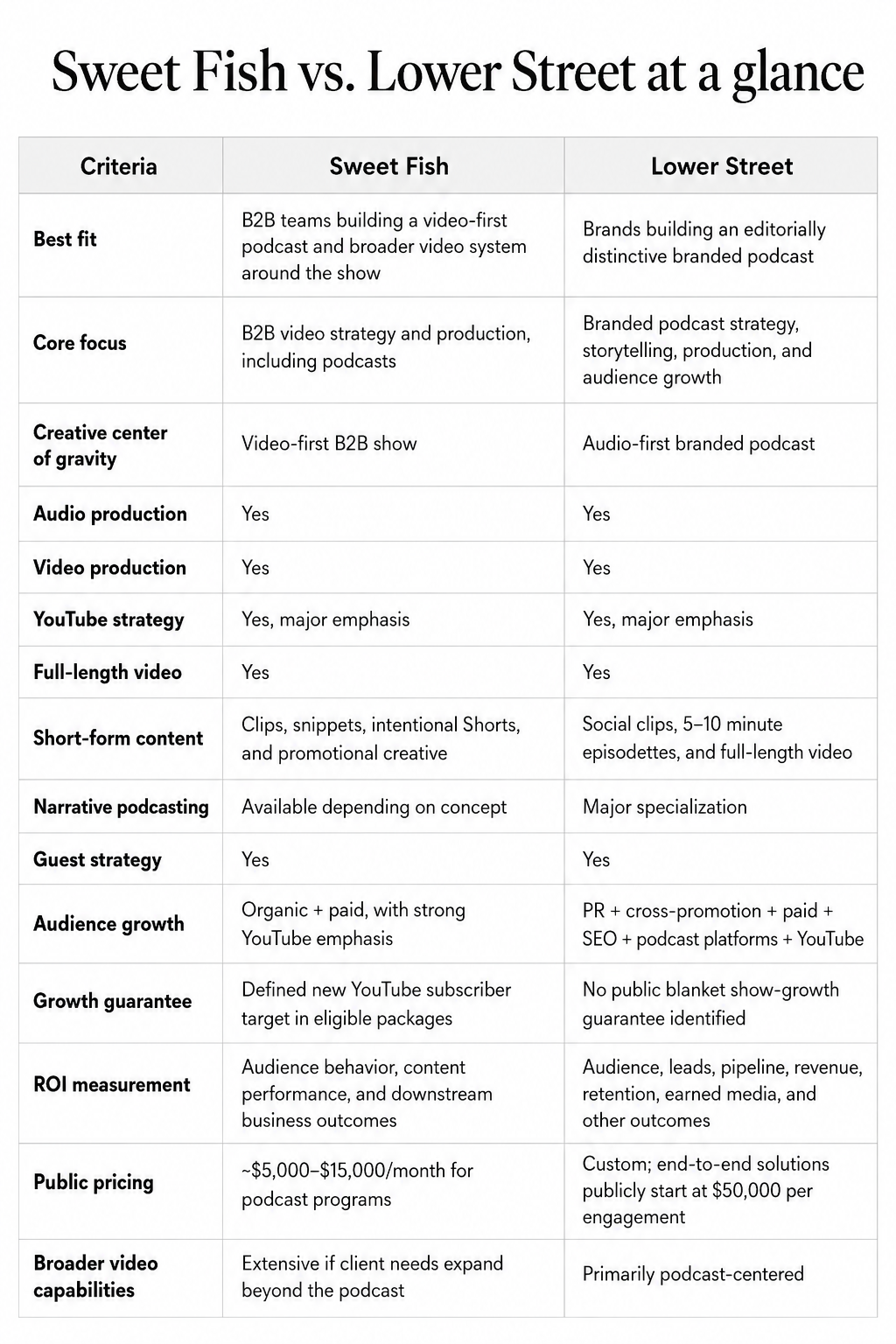
The short answer: Lower Street starts audio-first. Sweet Fish builds the show for audio and video from the beginning.
There’s significant overlap between the two agencies.
The useful distinction is how each thinks about the underlying show.
Lower Street leads with podcast storytelling
Lower Street describes itself as an audio-first podcast agency.
That shows up in the depth of its services around:
- narrative podcast development
- show concepting
- scripting
- research
- sound design
- editorial structure
- audience development
- podcast promotion
- PR
- SEO
- video podcasting
- YouTube
Audio-first does not mean audio-only.
Lower Street's current video offering is substantial. It produces full-length YouTube episodes, 5–10 minute standalone “episodettes,” and 30–60 second social clips.
Its video approach is designed to adapt the show to the medium rather than simply put cameras on an audio podcast and call it done.
If the thing you care most about is building a distinctive editorial property with deep podcast craft behind it, that specialization matters.
Sweet Fish builds the podcast as a video content engine
Sweet Fish has deep roots in B2B podcasting, but today operates as a broader B2B video partner.
For podcast clients, the show is still the recurring centerpiece.
Around that show, the content system can include:
- full-length video episodes
- full audio episodes
- clips and snippets
- intentional YouTube Shorts
- thumbnails
- trailers
- promotional assets
- paid creative
- platform-specific versions
- organic distribution
- paid distribution
The goal is to grow the show itself while making the recording investment work harder across the rest of the marketing mix.
That means the conversation isn't only about:
How do we make a great episode?
It's also about:
What else should this recording create, where should those assets live, and what should each one accomplish?
How do Sweet Fish and Lower Street approach show strategy and storytelling?
Both agencies help shape the show before anyone presses record.
This is also one of the clearest areas where Lower Street has built a distinctive specialization.
Lower Street has deep narrative and editorial capabilities
Lower Street makes a strong case that branded podcasts don’t need to default to interviews.
Its narrative podcast work can include:
- audience research
- concept development
- season planning
- episode research
- interview preparation
- transcription
- script writing
- narration
- editing
- music
- sound design
The format comes from the story and audience, not simply from what's easiest to produce.
That can result in shows that feel closer to editorial media or documentary storytelling than a typical recurring B2B interview series.
Lower Street has also built award-winning work in that model for brands including HPE and BCG.
If the brief sounds something like:
“We want this to feel like a premium editorial property or documentary series.”
Lower Street deserves a serious look.
Sweet Fish's strategy is particularly strong for personality-led B2B shows
Sweet Fish builds shows around the expertise, perspective, and personality already inside the company.
That can include:
- show positioning
- recurring formats and segments
- topic strategy
- episode outlining
- visual identity
- creative direction
- host training
- on-camera performance
- subject-matter expert development
The point isn't to put a camera in front of an executive and ask them what they want to talk about.
The show still needs a clear audience, a clear point of view, and a reason for someone to come back.
Sweet Fish can build narrative or highly produced formats when the strategy calls for them.
But if sophisticated audio storytelling is the core creative ambition, Lower Street has made that a more central part of its public specialization.
How do Sweet Fish and Lower Street approach video podcasting?
Both agencies take video seriously.
Lower Street adapts an audio-first show for video-native channels.
Sweet Fish builds the video experience into the show from the beginning.
Lower Street adapts the podcast for video-native platforms
Lower Street explicitly argues against simply uploading raw podcast footage to YouTube.
Its current model includes three major video formats.
Full-length episodes
Lower Street creates polished, YouTube-optimized versions of full episodes with visual CTAs, adjusted intros and outros, and other platform-specific changes.
Episodettes
These are 5–10 minute standalone pieces built around focused portions of the episode.
They can live on:
- YouTube
- blogs
- landing pages
They aren't just trailers. They're designed to work as content on their own.
Social clips
Lower Street also produces 30–60 second clips for channels such as YouTube Shorts, TikTok, and Instagram.
That's a meaningful video offering, especially for brands that want to extend an audio-first show into more visual channels.
Sweet Fish builds video into the underlying show
Sweet Fish approaches the podcast itself as an audio-and-video property.
That means decisions made before and during production need to support both experiences.
Depending on the show, that can include:
- set design
- visual identity
- lighting
- cameras
- framing
- host delivery
- segments
- episode structure
- long-form video
- short-form video
- thumbnails
- hooks
- promotional creative
The goal isn't to finish the audio show and then figure out what video can be salvaged from it.
Video is a core focus of the product from the beginning.
That matters especially when YouTube is expected to become one of the primary places the show gets discovered and grows.
How do Sweet Fish and Lower Street approach YouTube?
This is one of the areas where the agencies are more alike than different. Both understand that uploading a podcast to YouTube is not the same thing as having a YouTube strategy.
Lower Street has developed a real YouTube-native strategy
Lower Street talks explicitly about:
- discovery
- subscribers
- comments
- retention
- YouTube-native content
- adapting the show to video behavior
Sweet Fish makes YouTube audience development a core part of its video-podcast model
YouTube is also central to how Sweet Fish builds and grows shows.
We look at signals including:
- impressions
- click-through rate
- views
- watch time
- average percentage viewed
- audience retention
- subscriber growth
- search behavior
- engagement
- Shorts performance
Those signals tell us a lot more than whether the content was technically delivered.
They help us understand whether someone:
- chose the content
- kept watching
- engaged
- subscribed
- came back
And those learnings should change the show.
They can influence:
- topics
- hooks
- formats
- titles
- thumbnails
- Shorts
- publishing
- paid support
The show should get smarter as more audience behavior comes in.
Sweet Fish audience-growth programs also include a defined monthly target for new YouTube subscribers. If Sweet Fish misses that target, we fund the additional paid media needed to reach it.
We did not find a comparable public blanket audience-growth guarantee from Lower Street.
So if your question is:
“Which agency understands YouTube?”
The answer is:
Both.
The bigger difference is how each agency builds growth into the engagement and what it commits to measuring.
What happens to the content after an episode is recorded?
Both Sweet Fish and Lower Street expect a podcast to produce more than one long-form episode.
And neither stops at “cut three clips and throw them on LinkedIn.”
Lower Street uses a three-layer video model
Lower Street's current video model can be summarized as:
Full episode → Episodettes → Social Shorts
The full episode preserves the complete conversation.
The episodettes turn focused ideas into standalone mid-length content.
The Shorts create faster, discovery-oriented entry points.
That gives the audience several ways to encounter the show without requiring everyone to start with a full-length episode.
Sweet Fish builds different assets around different jobs
Sweet Fish also starts with the full show.
But a shorter asset shouldn't automatically be treated as a smaller version of the episode.
A great moment from a conversation may make an excellent LinkedIn clip.
It may be a terrible YouTube Short.
And the strongest organic Short may be completely wrong as a paid ad.
So instead of only asking:
“What's the best 30 seconds we can cut from this episode?”
Sweet Fish asks:
“What does this asset need to accomplish?”
That can lead to:
- clips built around strong moments from the conversation
- intentional Shorts designed to earn immediate attention
- promotional trailers
- snippets built around a specific POV
- paid creative built for a campaign objective
- curated segments from the longer episode
The footage may come from the same production.
The job of each asset can still be completely different.
Same footage. Different job. Different success metric.
How do Sweet Fish and Lower Street approach audience growth?
Neither agency is simply handing over finished episodes and wishing you luck.
Both actively work on growth.
They just bring different strengths to the problem.
Lower Street has deep podcast-specific promotion capabilities
Lower Street's podcast marketing services can include:
- audience positioning
- competitive analysis
- podcast PR
- earned media
- platform pitching
- cross-promotions
- feed swaps
- podcast network promotion
- host guest appearances
- SEO
- paid promotion
- owned-channel activation
- YouTube
Lower Street also puts meaningful emphasis on reaching people in environments where they're already consuming podcasts.
That includes cross-promotion, podcast apps, relevant media, earned placements, partnerships, and other podcast-native growth tactics.
If podcast-specific PR, feed swaps, cross-promotion, earned media, and network promotion are major parts of your growth strategy, Lower Street has especially deep capabilities there.
Sweet Fish combines content optimization with organic and paid audience growth
Sweet Fish takes a more video-platform-heavy approach.
For a video podcast, that can include:
- YouTube channel optimization
- title and thumbnail strategy
- long-form publishing
- Shorts
- social distribution
- paid audience growth
- performance testing
- ongoing creative iteration
YouTube gets particular attention because it gives us detailed behavioral signals about what the audience actually did.
A download tells you an episode was delivered.
YouTube can tell you whether someone:
- clicked
- watched
- kept watching
- engaged
- subscribed
- came back
That creates a much tighter feedback loop between distribution and creative strategy.
Lower Street has especially deep podcast-native audience development.
Sweet Fish leans especially hard into measurable video-platform growth, paid support, and continuous content optimization.
How do Sweet Fish and Lower Street measure podcast ROI?
Neither agency treats raw downloads as the only measure of success.
Lower Street connects podcast performance to business outcomes
Lower Street's case studies and marketing materials measure outcomes including:
- listens
- views
- retention
- subscriber growth
- earned media
- leads
- pipeline
- revenue
- sponsorship revenue
- thought leadership
Sweet Fish measures the show and supporting assets according to their jobs
Sweet Fish takes a similar business-outcome mindset, but because one production can create very different types of content, we don't expect every asset to win on the same metric.
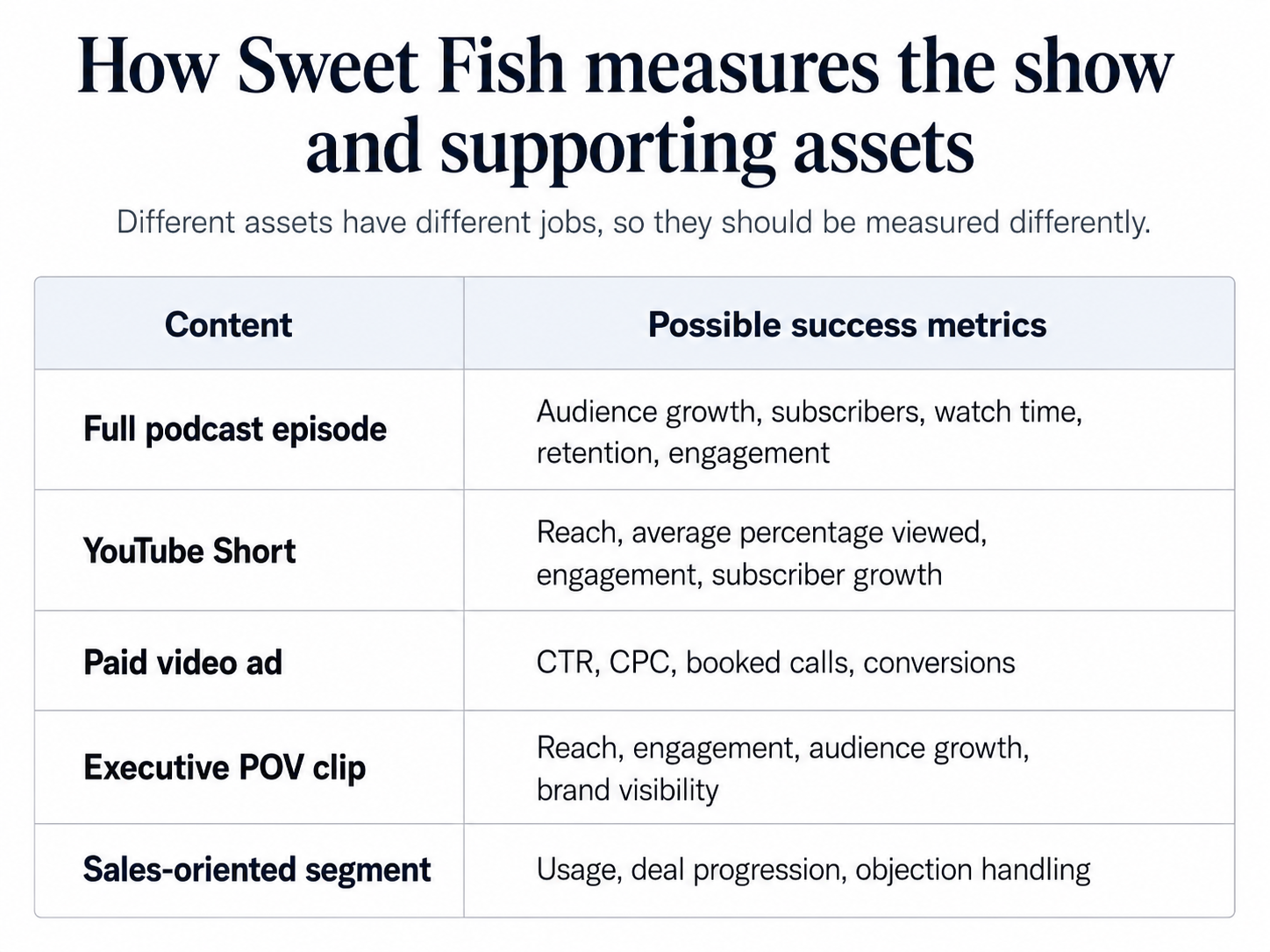
Where CRM and downstream revenue data are available, booked calls, pipeline signals, and attribution can also be part of the picture.
The philosophy is simple:
The KPI should follow the job the content was created to do.
How much do Sweet Fish and Lower Street cost?
Pricing is one of the harder parts of this comparison because Sweet Fish and Lower Street package their work differently.
How much does Lower Street cost?
Lower Street doesn’t publish a standard monthly price for its podcast work.
Its current “Is Lower Street a fit?” page says end-to-end engagements start at $50,000, but that’s a starting point for the engagement, not a monthly fee.
From there, pricing can move quite a bit depending on the format, number of episodes, production complexity, video requirements, and how much promotion is included. Lower Street’s own 2026 pricing guide points to broad full-service season ranges of roughly $40,000–$100,000+, with more complex programs reaching $100,000–$250,000+.
So if you’re trying to compare Lower Street directly to a monthly Sweet Fish package, the public pricing doesn’t really let you do that cleanly. You’d need a custom proposal based on the show you actually want to build.
How much does Sweet Fish cost?
Sweet Fish podcast programs generally range from $5,000–$15,000 per month.
Pricing depends on things like:
- publishing cadence
- remote versus in-person production
- number and type of assets
- organic distribution
- paid media
- audience-growth targets
- platforms
- production scope
Because the models are structured differently, the only reliable way to determine which agency is less expensive for your specific program is to compare actual proposals and scopes.
Lower Street may be the better choice if…
Lower Street is likely the stronger fit if:
- You want an editorially ambitious branded podcast.
- Audio craft and storytelling are especially important to the concept.
- You want to explore narrative, documentary, or highly produced podcast formats.
- You want an agency whose specialization is podcast strategy, production, and audience development.
- Podcast PR, feed swaps, cross-promotion, and earned media are major priorities.
- You're primarily thinking about the project as an audio-first podcast that will also extend into video.
- You value Lower Street's experience producing narrative and award-winning branded shows for enterprise organizations.
If those are the things you care most about, Lower Street's specialization makes a lot of sense.
Sweet Fish may be the better choice if…
Sweet Fish is likely the stronger fit if:
- You want the podcast designed as an audio-and-video B2B show from the beginning.
- You want full-length video, audio, Shorts, clips, promotional creative, and other supporting assets intentionally built around the show.
- You care particularly about building a measurable audience on YouTube.
- You value a defined monthly YouTube subscriber-growth target.
- You want the creative strategy to evolve based on audience behavior and content performance.
- You want your executives or subject-matter experts to become recognizable recurring personalities.
- You want short-form assets designed around the platform and job instead of treating every asset as a smaller cut of the episode.
- You want strategy, production, distribution, paid growth, and optimization handled by one team.
- You want the option to expand into events, customer stories, ads, executive content, sales enablement, and other video work without adding another partner.
For Sweet Fish podcast clients, the show remains the core recurring property.
The advantage is that the team around that show can also support the rest of the company's video roadmap when needed.
Sweet Fish vs. Lower Street: Which B2B podcast agency should you choose?
Choose Lower Street if you want a premium branded podcast built from an audio-first editorial perspective, with deep storytelling capabilities, polished production, video adaptation, and podcast-native audience development.
Choose Sweet Fish if you want a B2B show where audio, video, YouTube, short-form content, paid and organic distribution, and audience growth are planned together from the beginning, with the option to extend that same team into the rest of your video strategy.
Both agencies can build and grow a strong show.
The better question is what you're trying to build around it.
Lower Street starts with podcast storytelling and extends the show into video.
Sweet Fish builds the show as an audio-and-video property and creates the broader content system around it.
Frequently asked questions about Sweet Fish vs. Lower Street
What is the main difference between Sweet Fish and Lower Street?
Sweet Fish and Lower Street both provide podcast strategy, production, video, promotion, and audience growth. Lower Street publicly describes itself as audio-first and has particular depth in branded storytelling, narrative podcasting, production craft, and podcast-native promotion. Sweet Fish has deep B2B podcast expertise but operates as a broader B2B video partner, building the full show, YouTube strategy, supporting video assets, distribution, and audience growth together.
Is Sweet Fish a Lower Street alternative?
Yes. Sweet Fish is a strong Lower Street alternative for B2B companies looking for end-to-end video podcast strategy, production, distribution, and audience growth, particularly when video, YouTube, and broader marketing video needs are important to the program.
Is Lower Street a Sweet Fish competitor?
Yes. Lower Street and Sweet Fish overlap substantially in branded podcast strategy, audio and video production, YouTube, short-form content, promotion, and audience growth.
Which is better for B2B video podcasting: Sweet Fish or Lower Street?
It depends on the type of show you're building. Lower Street may be the better choice for editorially ambitious or narrative branded podcasts with an audio-first creative approach. Sweet Fish may be the better choice for B2B companies intentionally building an audio-and-video show around long-form content, YouTube, Shorts, promotional assets, paid and organic distribution, and measurable audience growth.
Does Lower Street produce video podcasts?
Yes. Lower Street produces full-length video podcast episodes, 5–10 minute standalone “episodettes,” and short social video. It also develops dedicated YouTube and video-growth strategies.
Is Lower Street audio-first?
Yes. Lower Street currently says it leads with an audio-first mindset while also producing full-length video and promotional content to increase a show's reach.
Does Lower Street help podcasts grow?
Yes. Lower Street offers dedicated podcast promotion that can include PR, cross-promotion, feed swaps, paid campaigns, SEO, platform pitching, earned media, strategic outreach, owned channels, and YouTube.
Does Lower Street offer YouTube strategy?
Yes. Lower Street develops video-native YouTube strategies rather than simply publishing raw podcast recordings. Its services include full-length YouTube episodes, episodettes, short-form video, platform optimization, and audience growth.
Does Lower Street make short-form video?
Yes. Lower Street creates 30–60 second social clips as well as 5–10 minute standalone “episodettes” designed for platforms including YouTube and LinkedIn.
Does Lower Street offer narrative podcast production?
Yes. Narrative podcasting is one of Lower Street's major specializations. Its process can include concept development, research, season planning, interview preparation, scripting, narration, editing, music, and sound design.
How much does Lower Street cost?
Lower Street uses custom pricing and publicly states that its end-to-end solutions start at $50,000. That is an engagement starting point, not a published monthly price. Actual cost depends on factors including format, episode volume, production complexity, video, marketing, and overall scope.
How much does Sweet Fish cost?
Sweet Fish podcast programs generally range from $5,000–$15,000 per month, depending on cadence, production requirements, asset mix, platforms, paid media, distribution, and audience-growth targets.
Does Lower Street guarantee podcast growth?
Lower Street has published significant audience-growth results and offers dedicated podcast promotion services, but as of our August 2026 review, we did not find a public blanket audience-growth guarantee covering every Lower Street engagement.
Does Sweet Fish guarantee podcast growth?
Eligible Sweet Fish audience-growth packages include a defined monthly target for new YouTube subscribers. If Sweet Fish does not reach that target, Sweet Fish funds additional paid distribution until it does.
Which agency is better for YouTube?
Both Sweet Fish and Lower Street have meaningful YouTube expertise, so neither is universally better. Lower Street has developed video-native formats and has strong YouTube growth case studies. Sweet Fish makes YouTube audience development a central part of its video-podcast model and offers defined subscriber-growth targets in eligible packages. The better choice depends on the show's creative model, audience strategy, and how heavily YouTube factors into the overall program.