


Video podcast production services can include everything from recording and editing to show strategy, audience research, content planning, YouTube packaging, short-form content, distribution, optimization, and reporting.
That’s why two “podcast production” partners can look almost nothing alike.
One may handle the technical side of the show: recording, editing, audio cleanup, and delivery.
Another may help you decide what the show should be about, who it’s for, how it should look, how each episode gets packaged, how the content gets distributed, and what should change based on performance.
For a B2B brand trying to build a show that actually grows, that second category usually matters a lot more.
Recording and editing are still important. They’re just the starting point.
A serious video podcast needs a clear audience, strong strategy, a recognizable format, good production, thoughtful distribution, and a system for learning from what works.
This guide breaks down what video podcast production services should include, what separates basic production support from a full-service video podcast partner, and what buyers should evaluate before hiring one.
Sweet Fish has produced shows for 450+ B2B brands, created more than 10,000 episodes, and generated millions of views across client channels and campaigns.
Recording and editing are table stakes
Every professional video podcast needs solid production.
You need cameras that look good. Audio that doesn’t make people reach for the volume button. Lighting that makes the set feel intentional. Editors who know how to build a clean episode.
That’s the baseline.
But if your goal is to grow the show, recording and editing alone won’t answer the harder questions.
Questions like:
- Who are we trying to reach?
- Why would they watch this show?
- Which topics actually have demand?
- What format makes sense for our audience?
- What should each episode accomplish?
- How should the episode be packaged for YouTube?
- Which moments should become short-form content?
- How are people going to discover the show?
- What’s working?
- What isn’t?
- What should we change next?
A production-focused vendor can still be the right partner if your internal team already owns all of that.
If you already have the strategy, topics, distribution, YouTube expertise, and performance analysis handled, you may simply need someone to make the show look and sound great.
But if you want a partner to help build and grow the show, you need more than cameras and an editor.
What should video podcast production services include?
A strong full-service video podcast partner should typically support:
- Strategy and audience research
- Show format and content development
- Professional production
- Custom visual identity
- Post-production
- YouTube strategy and packaging
- Short-form content
- Organic distribution
- Performance optimization
- Reporting
- Paid media, when appropriate
Not every partner will provide every one of these services.
That’s okay.
The important thing is understanding what your show needs and whether the company you’re hiring can actually support those needs.
1. Strategy and audience research
Strategy is one of the biggest differences between a production vendor and a true video podcast partner.
The shows that end too early usually don’t have a microphone problem. They have a strategy problem.
Maybe the show doesn’t have a clear audience.
Maybe the topics are based on what the company wants to say rather than what the audience wants to hear.
Maybe there’s no distribution plan.
Maybe the team has no idea what success looks like.
Maybe they’re publishing consistently but learning absolutely nothing from performance.
A strong video podcast partner should help solve those problems before production starts.
Start with the business goal
First, what is the show supposed to do?
That might be:
- build brand awareness
- grow an audience
- establish executive thought leadership
- support lead generation
- create sales enablement content
- strengthen customer relationships
- create a repeatable source of video
- build YouTube visibility
- support a larger campaign
- increase category authority
Those goals lead to very different strategies.
A show designed primarily for executive authority may look different from one built to grow a YouTube audience.
A show intended to support sales may need different guests, topics, clips, and calls to action than one focused on brand awareness.
The strategy should start with the job the show needs to do.
Understand the audience deeply
Then the partner should get very clear on who needs to care.
That means understanding:
- the ICP
- what they care about
- what they’re searching for
- what they’re watching
- where they spend time online
- what kinds of formats they engage with
- what questions they ask
- which topics already have demand
- what competing content already exists
This is where search research, YouTube research, audience behavior, buyer questions, sales feedback, and category analysis can all come together.
The goal is to build a show around real demand instead of guessing what might be interesting.
Strategy should drive the deliverables
A strong partner shouldn’t force every client into the same output formula.
One show may need:
- two long-form episodes each month
- eight shorts
- YouTube packaging
- LinkedIn distribution
- paid support
Another may need:
- weekly episodes
- a more aggressive short-form program
- heavy YouTube optimization
- executive clips
- sales enablement assets
Another may use the show primarily as source content for broader campaigns.
The deliverables should come from the strategy.
Proof to add: Client example showing how audience or search research shaped the show format, topic strategy, or distribution plan.
2. Show format and content development
Once the strategy is clear, someone still has to turn it into an actual show.
A good video podcast production partner should help with content development, not wait for you to send over a topic list every month.
That can include:
- show positioning
- recurring formats
- episode structure
- topic planning
- guest strategy
- guest preparation
- interview briefs
- episode outlines
- scripts
- hooks
- cold opens
- CTAs
- title concepts
- content calendars
The goal is to make the show easier to produce consistently and more useful to the audience.
Format matters
Not every B2B show needs to be two people sitting across from each other having a 45-minute conversation.
A format might include:
- expert interviews
- customer conversations
- panel-style discussions
- solo executive POV
- recurring educational segments
- teardown episodes
- debates
- tactical walkthroughs
- field interviews
- event-based episodes
The right format depends on the audience, goals, host, and type of expertise the company can consistently access.
A strong partner should help figure that out.
The partner should help plan what gets said
The most polished episode in the world still falls flat if the conversation isn’t useful.
Good content planning should help uncover:
- strong questions
- interesting angles
- specific examples
- useful stories
- relevant objections
- buyer problems
- clear takeaways
This is especially important in B2B, where the people on camera may be executives, technical experts, operators, customers, or partners who don’t spend their lives thinking about content.
They know their subject.
The production partner should know how to turn that expertise into a compelling show.
3. Professional production
This is the part most people picture when they hear “video podcast production.”
And yes, it still matters a lot.
A professional partner should be able to support:
- multi-camera production
- professional microphones
- lighting
- production crew
- audio monitoring
- directing
- studio production
- on-location production
- production logistics
- talent preparation
The exact setup depends on the show.
Studio production
A dedicated studio can be a strong fit for recurring shows and batch recording.
It gives the team more control over:
- lighting
- audio
- visual consistency
- equipment
- set design
- production speed
It can also make it easier to record several episodes in a short period of time.
On-location production
For some brands, the best production environment is their own office, event, facility, customer location, or existing studio.
A partner should be able to adapt.
On-location filming can make sense when:
- executives can’t travel
- the environment matters to the story
- customers are already in one place
- the company wants to capture an event
- the office or facility is part of the visual identity
The production model should support the content, not box it in.
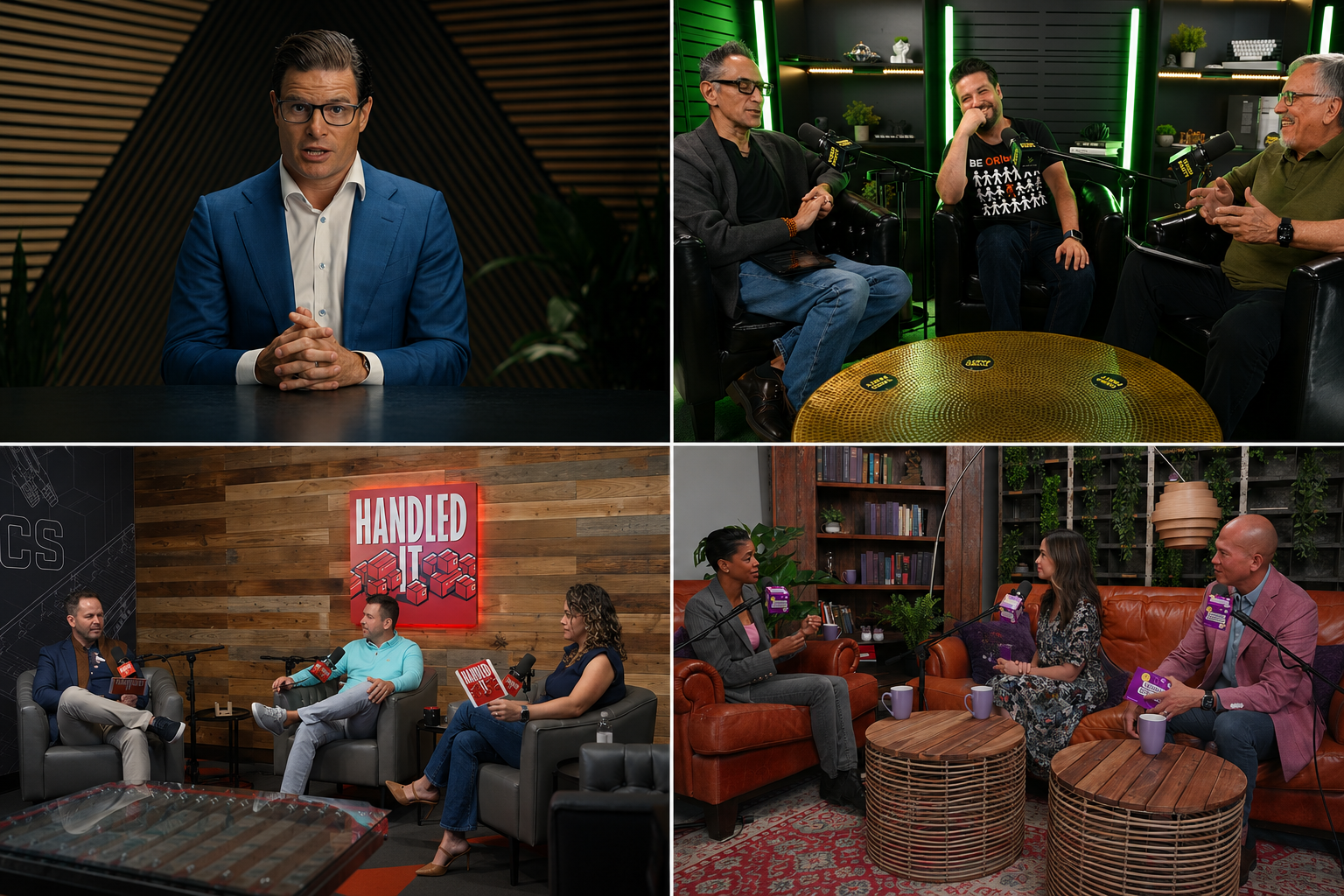
4. Custom visual identity and set design
Your show should look like your brand.
That includes more than adding a logo to the wall behind the host.
A strong video podcast partner should think about:
- set design
- backgrounds
- furniture
- lighting style
- camera framing
- cover art
- graphics
- colors
- motion design
- overall visual identity
The goal is recognition.
When someone sees a clip from your show in the feed, they should be able to recognize it quickly.
And your show shouldn’t look identical to every other client the production company works with.
A repeatable production process is useful.
A repeatable visual template for every brand is less useful.
5. Post-production should include more than a clean edit
Once production wraps, the raw footage needs to become content people will actually consume.
Post-production can include:
- long-form editing
- audio editing
- sound mixing
- color correction
- motion graphics
- captions
- cold opens
- hooks
- CTAs
- thumbnails
- titles
- descriptions
- trailers
- short-form edits
- platform-specific versions
- revision rounds
The strongest post-production decisions tie back to the strategy.
A YouTube episode needs to hold attention.
A short-form clip needs to work as a standalone idea.
A paid ad needs a hook almost immediately.
A sales clip may need to answer one objection in 45 seconds.
Those assets may come from the same recording, but they don’t have the same job.
One recording can produce a lot more than one episode
A well-planned podcast recording can become:
- a full-length YouTube episode
- an audio podcast episode
- YouTube Shorts
- LinkedIn videos
- Instagram clips
- executive thought leadership
- paid creative
- sales enablement
- trailers
- newsletter material
- article insights
This is where video podcasts become especially valuable for B2B marketing teams.
You’re already getting the right people together and having the right conversation.
You should get as much useful content from that moment as possible.
6. YouTube strategy is mandatory for a modern video podcast
If you’re producing a video podcast in 2026, YouTube should be part of the strategy.
Simply uploading the episode to YouTube isn’t enough.
A serious video podcast partner should understand:
- topic selection
- titles
- thumbnails
- descriptions
- search intent
- hooks
- cold opens
- audience retention
- channel strategy
- publishing
- playlists
- CTR
- average percentage viewed
- watch time
- subscriber growth
YouTube gives video podcasts a much larger discovery opportunity than an audio feed alone.
But that only matters if the content is packaged well.
Earning the click
Before someone watches your episode, they need to choose it.
That means the title and thumbnail have a huge job.
The partner should be looking at:
- CTR
- topic appeal
- title structure
- thumbnail clarity
- audience relevance
If nobody clicks, the quality of the conversation doesn’t get a chance to matter.
Holding attention
Once someone clicks, the next challenge is keeping them.
That’s where metrics like:
- average percentage viewed
- retention
- watch time
- early drop-off
become useful.
If people leave quickly, the partner should look at:
- the cold open
- the hook
- pacing
- episode structure
- intro length
- topic alignment
Then those learnings should affect future episodes.
Check out how Sonar Software earned hundreds of thousands of views with Sweet Fish.
7. Short-form content should drive discovery
Short-form video is a major discovery channel for modern video podcasts.
A strong short can introduce someone to:
- the host
- the guest
- the topic
- the brand
- the long-form show
It can also create repeated exposure across social channels and help grow the broader audience.
That means short-form content deserves more thought than “find five clips from every episode.”
Good shorts work on their own
A short-form video should make sense even if the viewer has never seen the full episode.
That means it may need:
- a stronger hook
- added context
- tighter editing
- different pacing
- text overlays
- a clearer payoff
- channel-specific framing
The best moment in the long-form episode isn’t always the best short.
Strong short-form strategy looks for ideas that can stand alone.
Shorts can support long-form growth
Short-form content can also help people discover the larger show.
A viewer may first encounter the brand through a 40-second clip, then watch another, then subscribe, then eventually spend 30 minutes with a full episode.
That journey matters.
Shorts can support:
- organic reach
- channel growth
- repeated exposure
- topic testing
- audience development
- long-form discovery
For a modern video podcast, they should be part of the strategy from the beginning.
8. Organic distribution should be part of the service
A finished episode sitting in a folder has no audience.
Your video podcast partner should have a plan for what happens after production.
Organic distribution may include:
- YouTube
- YouTube Shorts
- newsletters
- websites
- guest channels
- employee amplification
- sales distribution
You don’t necessarily need every channel.
You need the channels where your audience actually spends time.
Distribution should be planned before production
If we know an episode also needs to support:
- YouTube Shorts
- sales
- a paid campaign
that should affect the production plan.
We may need to capture certain answers differently.
We may want shorter standalone moments.
We may want specific CTAs.
We may need additional framing.
Planning distribution early gives you better raw material.
9. Paid media can accelerate the right show
Paid media isn’t a requirement for every podcast production company.
For a full-service partner, though, it can be a valuable capability.
Paid promotion can help:
- reach the ICP directly
- amplify strong episodes
- distribute short-form content
- launch a new show
- retarget engaged viewers
- test creative angles
- support specific campaigns
Sometimes waiting for organic distribution alone is slower than the business goal allows.
Paid media gives you more control over who sees the content.
The important part is treating paid distribution as its own strategy.
That means considering:
- audience
- platform
- creative
- CTA
- objective
- cost
- conversion behavior
A clip that works organically may not automatically make the best ad.
10. The best partners continuously optimize the show
A serious video podcast partner should be watching what happens after the episode goes live.
That can include:
- CTR
- average percentage viewed
- retention
- watch time
- impressions
- views
- subscriber growth
- engagement
- conversions
- paid media performance
The goal isn’t to collect metrics for the sake of having a dashboard.
The point is to learn something.
What gets optimized?
Potentially:
- titles
- thumbnails
- hooks
- cold opens
- topics
- guests
- episode length
- structure
- formats
- CTAs
- short-form strategy
- publishing
- distribution
- paid creative
If the thumbnail isn’t earning clicks, test another one.
If viewers drop quickly, look at the opening.
If one topic consistently performs better, build more around it.
If a certain type of short drives subscriber growth, create more of that format.
The show should get smarter over time.
11. Reporting should explain what’s happening and what changes next
You can’t improve a show if nobody knows how it’s performing.
Reporting should help the client understand:
- what’s working
- what isn’t
- why
- what the team has learned
- what should change next
That can include:
- performance dashboards
- regular performance updates
- editorial reviews
- content strategy discussions
- channel reporting
- quarterly business reviews
The most useful reporting connects performance directly to action.
Maybe the next quarter needs:
- different topics
- new thumbnail direction
- stronger cold opens
- more shorts
- fewer shorts
- a format change
- more aggressive distribution
- new paid creative
The data should help drive those decisions.
A monthly spreadsheet with a bunch of green arrows isn’t enough.
Basic podcast production vs. a full-service video podcast partner
There’s a big difference between hiring someone to produce your episodes and hiring someone to help build and grow the show.
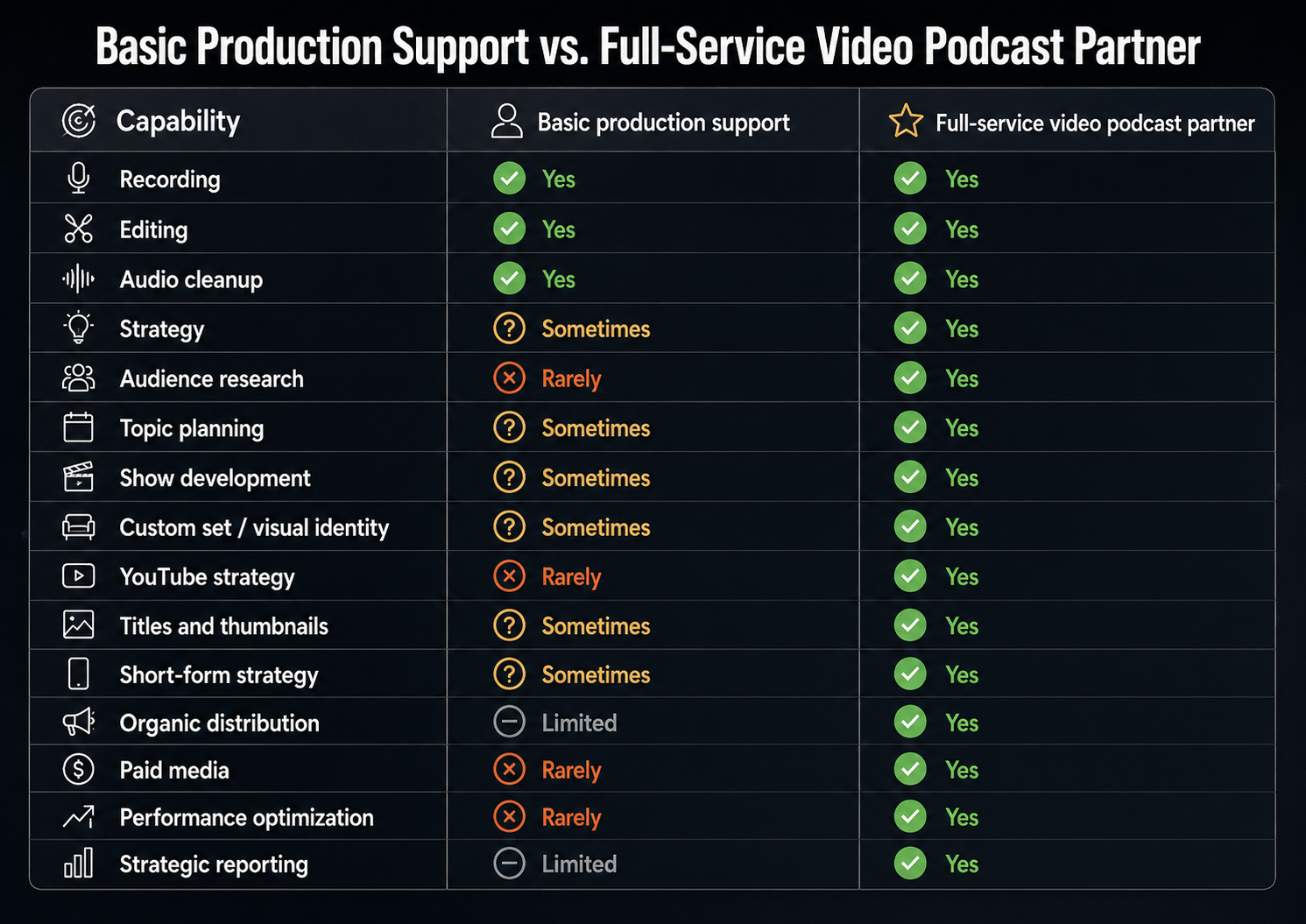
Neither model is automatically better.
It depends on what you already have internally.
If your team has a strong show strategy, YouTube expertise, distribution plan, and analytics capability, production support may be plenty.
If you need help answering the bigger strategic questions and growing the show over time, a full-service partner is usually a better fit.
Questions to ask a video podcast production company before you hire them
Before hiring a video podcast production company, ask questions that go beyond cameras and editing.
1. Who owns the show strategy?
Find out whether the partner will help define the audience, goals, positioning, format, and distribution strategy or whether your team needs to provide all of that.
2. How do you research our audience and topics?
Ask what data they use.
Search behavior? YouTube? Competitor content? Buyer questions? Sales insights?
3. Who plans each episode?
Will they develop topics and briefs, or are you expected to hand them the complete content plan?
4. Do you help with show positioning and format?
A new show may need help defining what makes it distinct and repeatable.
5. Where can you film?
Ask about studio production, on-location filming, travel, events, and remote options where relevant.
6. Do you design custom sets?
Find out whether your visual identity is built around your brand or pulled from a standard template.
7. What’s included in post-production?
Get specific.
Ask about:
- long-form editing
- sound
- color
- graphics
- captions
- short-form video
- thumbnails
- titles
- descriptions
8. Do you create short-form content?
If so, ask how they decide which moments become shorts and how they optimize those clips for discovery.
9. How do you approach YouTube?
This one matters.
Ask who owns:
- titles
- thumbnails
- topic strategy
- publishing
- optimization
- performance analysis
10. Do you handle distribution?
Find out whether they simply deliver assets or also help publish and distribute them.
11. Do you offer paid promotion?
You may not need it, but it’s useful to understand whether the partner can support paid growth if needed.
12. What metrics do you track?
Listen for more than views.
A strong partner should be able to explain which metrics matter and why.
13. How often do you optimize the show?
Performance analysis should lead to changes.
Ask how regularly they revisit titles, thumbnails, content formats, topics, and creative.
14. What does reporting look like?
Ask whether you get dashboards, recurring performance reviews, strategic recommendations, and QBRs.
15. Can you show sustained audience growth?
One viral clip is nice.
Look for examples where the partner helped a show improve over time.
16. Can you show examples from other B2B brands?
B2B content has different challenges from consumer entertainment.
Relevant experience matters.
17. What happens if the show stops growing?
This is a great question.
The answer tells you whether the company thinks like a production vendor or a growth partner.
18. Who will actually work on our account?
Understand who owns strategy, production, editing, distribution, and performance.
19. What does our internal team still need to own?
This might be the most practical question on the list.
Know exactly where the agency’s work stops and your team’s work begins.
How much do video podcast production services cost?
Video podcast production services can range from a few thousand dollars per month for editing and production support to $15,000+ per month for full-service programs that include strategy, professional production, YouTube, short-form content, distribution, paid media, and ongoing optimization.
The biggest cost drivers include:
- production cadence
- filming location
- number of deliverables
- strategy support
- editing complexity
- short-form volume
- distribution
- paid promotion
For a full breakdown, read our guide to video podcast production costs.
How Sweet Fish approaches video podcast production
Sweet Fish Media works as a full-service B2B video podcast partner.
Our process can include:
- audience and search research
- show strategy
- topic and content planning
- show development
- custom set design
- studio or on-location production
- long-form editing
- social shorts
- YouTube titles and thumbnails
- organic distribution
- paid promotion
- ongoing optimization
- performance reporting
We’ve produced shows for more than 450 B2B brands, created more than 10,000 episodes, and helped client content generate millions of views.
The goal is to make the show useful well beyond the full-length episode.
A single recording can support YouTube, social, executive thought leadership, paid media, sales enablement, and the rest of your video strategy.
If you want to understand the broader way we work, read What Does Sweet Fish Media Do? and our guide to The Sweet Fish Video System.
Frequently asked questions about video podcast production services
What are video podcast production services?
Video podcast production services help companies plan, record, edit, package, distribute, and grow video podcast content. Services may include show strategy, audience research, content planning, professional production, post-production, YouTube optimization, short-form video, distribution, analytics, and reporting.
What should video podcast production services include?
A full-service video podcast partner should typically support strategy, content planning, professional production, post-production, custom visual identity, YouTube, short-form content, distribution, optimization, and reporting. Some partners also offer paid media and audience growth support.
What does a video podcast production company do?
A video podcast production company can help with cameras, audio, lighting, recording, editing, and publishing. More comprehensive companies may also support show strategy, audience research, topic development, YouTube growth, short-form content, distribution, analytics, and ongoing optimization.
What’s the difference between a podcast editor and a video podcast partner?
A podcast editor primarily works with recorded footage or audio to create finished episodes. A full-service video podcast partner can also help with audience strategy, show development, production, YouTube, short-form content, distribution, performance analysis, and growth.
Does video podcast production include strategy?
It can. Basic production providers may focus primarily on recording and editing, while full-service video podcast partners typically help with audience research, show positioning, topics, formats, content planning, and distribution strategy.
Should a video podcast production company help with YouTube?
Yes, especially for a video-first show. A modern video podcast partner should understand YouTube titles, thumbnails, search, CTR, retention, watch time, audience development, and ongoing optimization rather than simply uploading finished episodes.
Should a video podcast partner create social clips?
For most B2B shows, yes. Short-form video can support organic discovery, repeated exposure, social distribution, channel growth, and long-form performance. The strongest clips are edited to work as standalone content rather than simply pulled from the episode without context.
Does podcast production include distribution?
Some providers only deliver the finished assets, while full-service partners may also handle YouTube publishing, social distribution, email, guest amplification, paid media, and other channels. Buyers should clarify exactly what distribution support is included before hiring a partner.
How do video podcast companies help grow a show?
Video podcast companies can help grow a show through audience research, stronger topic selection, YouTube packaging, titles, thumbnails, short-form discovery, organic distribution, paid promotion, and ongoing optimization based on metrics such as CTR, retention, APV, watch time, subscriber growth, and engagement.
How much do video podcast production services cost?
Video podcast production services can cost several thousand dollars per month for editing and production support and $15,000+ per month for full-service programs that include strategy, professional production, YouTube, short-form content, distribution, paid promotion, and optimization.
What should I look for in a B2B video podcast partner?
Look for B2B experience, strategic capabilities, professional production, strong visual work, content planning, YouTube expertise, short-form strategy, distribution, performance optimization, transparent reporting, and relevant case studies showing sustained audience or business results.
Can a video podcast partner film at our office or event?
Many full-service video podcast partners offer on-location production in addition to studio filming. This can include client offices, events, customer locations, company studios, and other environments depending on the production requirements.
Choose a video podcast partner based on the job you need them to do
If your team already owns the strategy, audience research, topics, YouTube, distribution, and performance analysis, you may only need a great production company.
There are plenty of good ones.
If you want a partner to help build the show, produce it, get it discovered, and keep improving it over time, look for a company that can support more of the system.
That means asking about strategy just as much as cameras.
Asking about YouTube just as much as editing.
And asking what happens after the episode goes live.
If you want Sweet Fish to help build and grow your B2B video show, book a call with our team.