


Last updated: August 2026
Editorial note: This comparison is published by Sweet Fish. Information about Fame comes from Fame's publicly available website and was reviewed in August 2026. We've tried to represent both services accurately, including the situations where Fame may be the stronger fit.
Sweet Fish and Fame both help B2B brands launch, produce, distribute, and grow podcasts. The biggest difference is what each company is built around and what you want that investment to do for the rest of your marketing.
Fame is a podcast-specialist agency powered by Fame OS, its proprietary platform for guest booking, production QA, promotion, growth tracking, and guest-to-deal ROI attribution. Fame guarantees an average of 10% month-over-month download growth across the first six months or the seventh month is free.
Sweet Fish has deep roots in B2B podcasting, but today works as a broader B2B video partner. We produce and grow shows, but the podcast can also become source material for YouTube, organic social, paid campaigns, sales enablement, customer stories, events, executive thought leadership, and other video needs across the marketing team.
Sweet Fish audience-growth packages include a guaranteed number of new YouTube subscribers every month based on the client's audience and distribution plan. If the guaranteed number isn't reached, Sweet Fish funds the additional paid media needed to hit it.
Neither agency is automatically the better choice.
If your primary goal is to operate and grow a B2B podcast as its own marketing program, Fame has built a focused system around exactly that job.
If you want to grow a show while also building a broader, repeatable video system around it, Sweet Fish is built for a different kind of engagement.
Sweet Fish vs. Fame at a glance
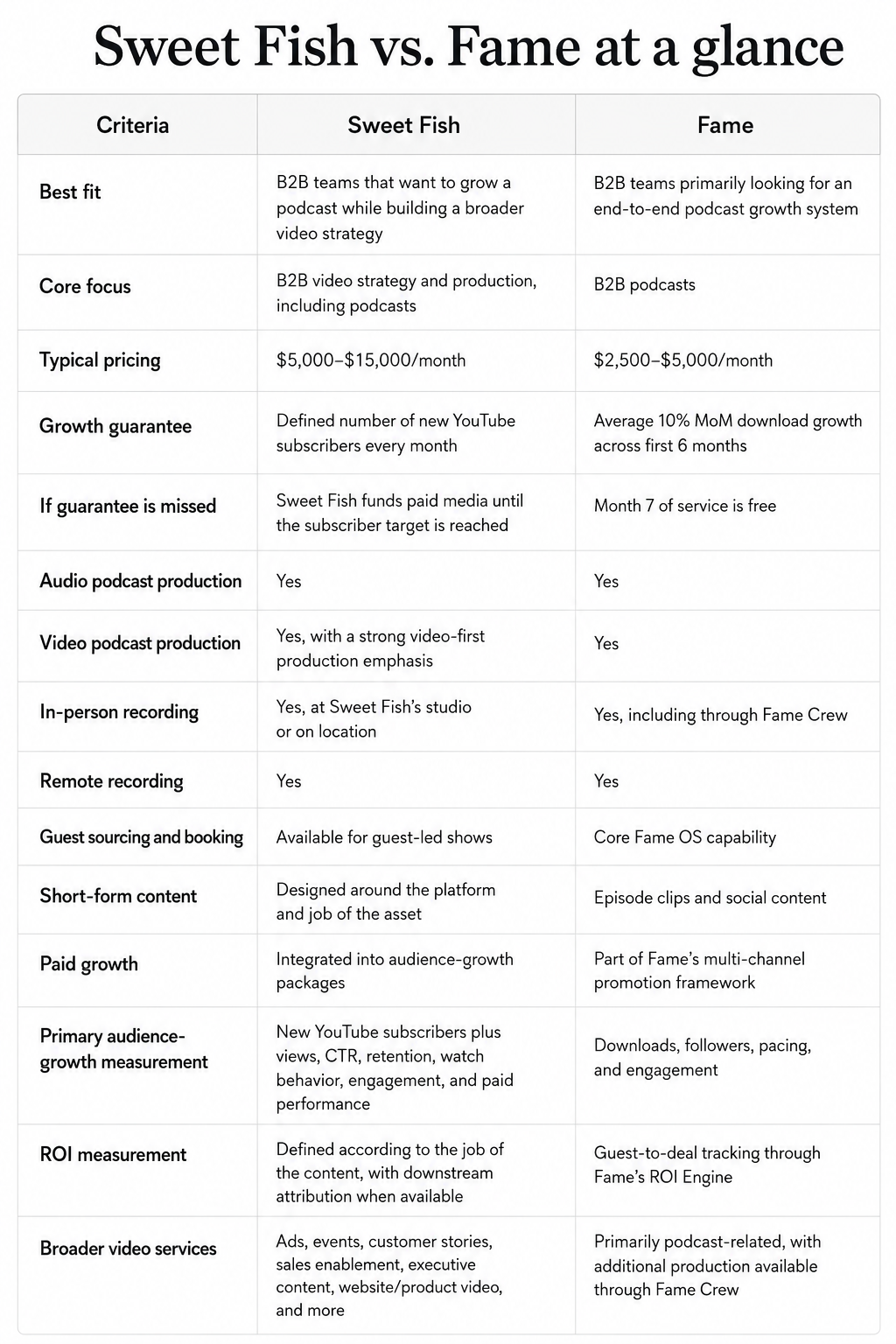
The short answer: Fame specializes in B2B podcasts. Sweet Fish specializes in B2B video.
Both agencies can launch, produce, promote, and grow a B2B podcast.
The more useful question is what you want the relationship to become.
Fame is built specifically around running and growing B2B podcasts
Fame describes itself as exclusively focused on B2B podcasts. Every Fame client runs through Fame OS, which the company says has been developed across more than 300 B2B shows and contains five core engines for guest acquisition, production, promotion, growth tracking, and ROI reporting.
The podcast itself sits at the center of the service.
Fame sources guests, produces episodes, creates promotional assets, distributes the show across multiple channels, tracks audience growth, and connects guest relationships to potential commercial outcomes.
If the job you need an agency to do is run and grow the podcast, Fame has built specifically for it.
Sweet Fish has deep podcast expertise, but the relationship can extend far beyond the show
Podcasting is one of Sweet Fish's deepest areas of expertise. We develop shows, produce them, distribute them, grow the audience, and optimize performance. We’ve created 450+ shows for today’s best B2B brands.
But today, the podcast is often one part of a much broader video strategy.
The same team producing your show can also:
- capture your events
- build paid video campaigns
- produce customer stories
- create sales enablement content
- film product and website video
- build executive thought leadership
- produce short-form organic content
- support YouTube growth
That creates a different operating model.
Fame productizes the podcast operating system.
Sweet Fish puts a broader video team around the marketing organization.
What is Fame?
Fame is a B2B podcast agency built around an end-to-end podcast production and growth model. Its current positioning centers heavily on Fame OS, which it describes as the software layer powering every client engagement.
Fame calls the model “half software, half strategists.”
How Fame OS works
Fame OS is built around five core engines:
Guest Engine: Defines the show's ideal guest persona, uses AI to match potential guests, supports personalized outreach, and tracks booking activity.
Production Engine: Supports recording and takes episodes through editing, clips, thumbnails, show notes, AI quality gates, and human review.
Promotion Engine: Distributes video-first podcast content across YouTube, Spotify, Apple, social platforms, search, and additional promotional channels.
Growth Radar: Tracks downloads, followers, engagement, and the show's progress against Fame's growth target.
ROI Engine: Tracks guests from the original conversation through relationships, opportunities, and deals, with a monthly report designed to show commercial value.
Fame says Fame OS has learned from more than 300 podcasts, 100,000 published episodes, 10 million downloads, and 10,000 social clips. These are Fame-reported figures.
What is Fame's 10% podcast growth guarantee?
Fame guarantees that a client's show will achieve an average of 10% month-over-month download growth across the first six months.
If the show does not hit that average by the end of month six, Fame provides the seventh month of service free.
Fame also reports that 98% of its clients have experienced 10%+ monthly growth during their first six months and that the average client reaches 18,957 downloads at six months. Those numbers come from Fame's own reporting.
How much does Fame cost?
Fame currently publishes pricing of $2,500–$5,000 per month, depending on episode volume and scope.
A typical engagement includes 2–4 episodes per month, with the full Fame OS platform, a dedicated strategist, and a project manager included at every tier. Fame also offers a lighter-touch Fame Lite service.
What is Sweet Fish?
Sweet Fish is a B2B video agency that works as an extension of the client's marketing team.
Podcasting is still a major part of what we do, but we don't assume the podcast is the only video format a company needs or that every asset created from a recording should do the same job.
A long-form podcast episode might be designed to build authority and deepen engagement.
A YouTube Short might be designed to maximize reach.
A paid video might be designed to generate clicks or booked calls.
A customer clip might help a sales team overcome an objection.
An event shoot might create an entire quarter of usable source footage.
That leads to a simple operating philosophy:
Define what the content needs to accomplish first. Then build the strategy, creative, production, distribution, and measurement around that outcome.
Sweet Fish is human-led, but still systemized
Sweet Fish has a repeatable process for strategy, production, distribution, optimization, and reporting.
What we don't try to standardize is the actual creative strategy.
The right mix of:
- formats
- production style
- channels
- topics
- paid support
- short-form
- long-form
- distribution
- success metrics
should depend on the brand, audience, goals, and funnel.
That means the operating system is repeatable, but the video strategy itself is highly customized.
And instead of relying on one generalist, Sweet Fish typically puts a multidisciplinary team around the client, including specialists across strategy, production, editing, distribution, YouTube, paid media, and performance.
How Sweet Fish approaches podcast audience growth
Sweet Fish uses an integrated organic and paid strategy, with a particular emphasis on building measurable audiences on YouTube.
Depending on the package, clients receive a defined monthly guarantee for new YouTube subscribers. That target is developed based on factors including the client's total addressable audience and paid distribution plan.
Paid media budget is included in the engagement, with higher tiers available for companies that want to reach and grow a larger audience.
If Sweet Fish doesn't hit the guaranteed monthly subscriber number, we fund the additional paid media until we do.
How much does Sweet Fish cost?
Sweet Fish podcast engagements generally range from $5,000–$15,000 per month.
Pricing varies based on factors including:
- publishing cadence
- remote vs. in-person production
- number and type of assets
- organic distribution
- paid media
- audience-growth targets
- platforms
- additional video needs
That makes Sweet Fish generally more expensive than Fame.
And that's important context.
If all you need is a well-run B2B podcast, Fame's lower price point might make significantly more sense.
If your marketing team would otherwise hire separate partners for podcast production, video shoots, short-form editing, paid creative, event content, customer videos, and other production needs, comparing the two based only on the monthly podcast fee doesn't tell the whole story.
The better budgeting question may be:
Are you comparing podcast budgets or total video budgets?
How do Sweet Fish and Fame approach podcast growth differently?
Both agencies believe publishing a podcast without actively distributing it is a bad strategy.
Both use organic and paid promotion.
Both create video.
Both care about audience growth.
The biggest difference is in how that growth is measured and what the teams optimize around.
Fame guarantees growth in podcast downloads
Fame's Growth Radar monitors downloads, followers, pacing, and engagement against its 10% growth target. Fame says the system scores every show daily so its strategists can intervene when growth moves off pace.
Fame's broader podcast promotion strategy is extensive.
The company's published 8 Pillars of Podcast Promotion include:
- Video, audio, and written SEO
- Organic social
- Guest amplification
- Communities and strategic partnerships
- Paid social/platform distribution
- Paid promotion on other podcasts
- Cold email
- Existing owned client channels
Fame uses these channels together rather than simply publishing an episode and waiting for organic discovery.
That's worth giving them credit for. Fame has built a real distribution system around podcast growth, not just production with a growth guarantee attached.
Sweet Fish puts greater emphasis on YouTube audience growth
Sweet Fish tracks podcast performance across channels but puts particular emphasis on YouTube because of the depth of behavioral data available.
A podcast download is useful as a reach signal, but it tells you less about what happened after the content was delivered.
With YouTube, we can see signals including:
- impressions
- click-through rate
- views
- watch time
- average percentage viewed
- audience retention
- search behavior
- subscriber growth
- comments
- shares
- engagement
That gives the Sweet Fish team more information about not only whether the content reached someone, but whether the audience chose it, watched it, engaged with it, and came back for more.
Those signals can then influence future:
- topics
- hooks
- titles
- thumbnails
- formats
- clips
- distribution
- paid support
The show should get smarter as more performance data comes in.
Fame guarantees percentage growth. Sweet Fish guarantees new subscribers.
The guarantees are structured differently.
Fame guarantees an average 10% month-over-month increase in downloads during the first six months.
Sweet Fish guarantees a defined number of new YouTube subscribers each month.
Neither metric is perfect or universally better.
A percentage-based target scales relative to the show's existing audience.
An absolute subscriber target tells the company how many new audience members it should expect to add each month.
The important question for buyers is:
Which audience-growth metric actually matters to your strategy?
How do Sweet Fish and Fame approach video podcasting?
Both Fame and Sweet Fish produce video podcasts.
Fame's current positioning is explicitly video-first in several places, so calling Fame an audio-only agency would be inaccurate. Fame produces full video episodes, clips, thumbnails, and content for YouTube and social platforms.
Fame also offers in-person production through Fame Crew, which deploys videographers for office, event, and studio shoots.
The distinction isn't whether either agency can produce video.
It's how broad a role video plays in the engagement.
Sweet Fish treats the recording as source material for a broader video system
Sweet Fish prefers in-person production where it makes sense, either in our studio or on location with the client.
That gives the production team control over:
- set and visual identity
- lighting
- cameras
- framing
- sound
- pickups
- creative direction
- consistency across episodes and assets
It also lets clients batch significant amounts of content efficiently. A one- or two-day shoot can capture an entire quarter of long-form episodes while generating source material for additional video content.
Remote production is still available, with producers supporting recordings and managing the production process when travel or in-person capture isn't practical.
But the larger opportunity comes from thinking beyond the episode itself.
Sweet Fish isn't only asking:
How do we turn this into a podcast episode?
We're also asking:
What else does the marketing team need while these executives, customers, or experts are already in front of a camera?
What happens to the content after the podcast is recorded?
Both Sweet Fish and Fame repurpose podcast content.
Fame includes clips, written content, show notes, YouTube publishing, SEO, and social distribution in its broader growth model.
Sweet Fish approaches repurposing from the job of the asset.
Not every short-form video should just be a podcast clip
A podcast recording gives you a lot of source material.
But the best asset for LinkedIn isn't automatically the best asset for YouTube Shorts.
And the best organic clip may be a terrible paid ad.
Instead of asking only:
“What's the best 30 seconds we can cut from this episode?”
Sweet Fish increasingly asks:
“What does this platform need, and what can we intentionally capture while we're already producing?”
That could mean the same recording day produces:
- long-form podcast episodes
- YouTube Shorts
- LinkedIn thought leadership
- paid video ads
- executive clips
- sales enablement
- website video
- customer proof
- email content
The footage can be related without every asset doing the same job.
Same footage. Different job. Different success metric.
That's especially important if the podcast budget is ultimately part of a broader content or video marketing budget.
How do Fame and Sweet Fish approach podcast guest booking?
Guest acquisition is much more central to Fame's operating model.
Fame uses guests as both audience and pipeline opportunities
Fame's Guest Engine builds an ideal guest persona, uses AI to match potential guests, supports personalized outreach, and tracks booking velocity.
Fame says great guests are important not only because they help the show grow, but because the guests themselves can become partnerships or sales opportunities. Its ROI Engine then tracks those relationships from conversation to opportunity to deal.
If your podcast is designed partly as a relationship-building or account-development motion, that approach may be particularly valuable.
Sweet Fish increasingly centers the company's own experts
Sweet Fish still provides guest sourcing and booking when a show calls for it.
That can include:
- guest strategy
- sourcing
- vetting
- outreach
- scheduling and coordination
But many of the shows Sweet Fish currently builds use recurring internal experts or co-hosts rather than relying on a new external guest every episode.
Why?
Because if the goal is to build your company's thought leadership, there's a strong argument for making your experts the people the audience comes back to hear.
Guest-led shows can be extremely effective.
But brands should answer one strategic question before defaulting to that format:
Who do you want your audience to remember at the end of the episode: your guest or your own experts?
The answer may determine which show structure makes more sense.
How do Sweet Fish and Fame measure podcast ROI?
Fame has packaged podcast ROI particularly well for guest-driven shows.
Fame tracks guests from conversation to deal
Fame's ROI Engine tracks the commercial progression of podcast guests from the initial conversation through relationships, opportunities, and deals.
That makes Fame especially interesting for companies using podcast guest strategy as part of business development.
Fame's own six-month example models both a guest side and a listener side of podcast ROI, with the company expecting guest-driven ROI to emerge earlier while audience-driven revenue develops as the show grows.
Sweet Fish defines ROI based on the job of the content
Sweet Fish takes a broader approach because not every video is supposed to produce the same outcome.
Before production, we align on what the content is actually supposed to accomplish.
For example:
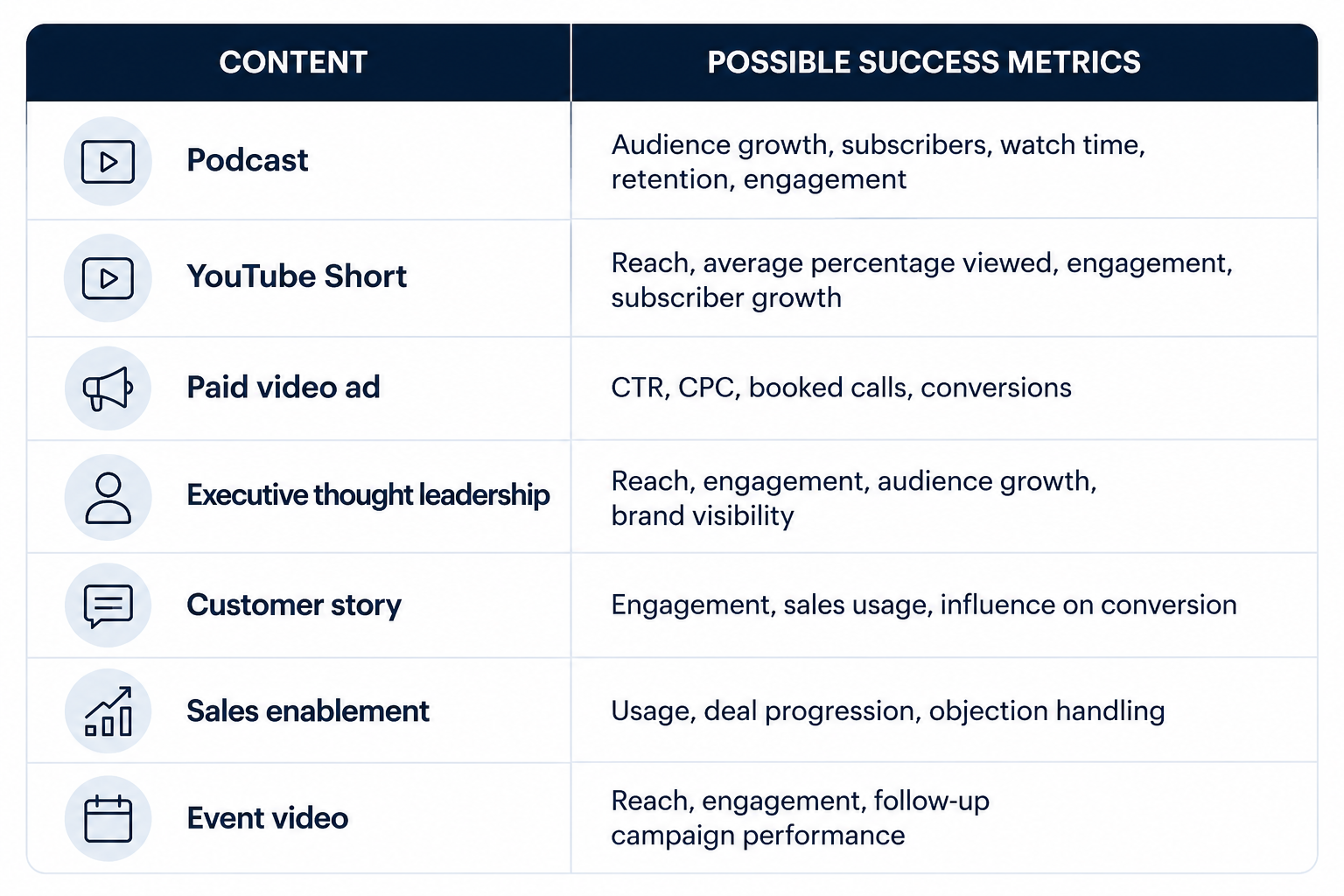
Where clients provide CRM and downstream revenue data, Sweet Fish can incorporate booked calls, attribution, pipeline signals, and other business outcomes into the optimization process.
But the philosophy stays the same:
The KPI should follow the job the content was created to do.
Sweet Fish vs. Fame pricing
There is a meaningful price difference between Sweet Fish and Fame.
Fame costs approximately $2,500–$5,000 per month
Fame publicly lists its pricing at $2,500–$5,000 per month, typically for 2–4 episodes per month depending on scope.
Every tier includes Fame OS, the Guest Engine, Production QA, Promotion Engine, Growth Radar, ROI reporting, a strategist, and a project manager.
Fame describes a typical client month as including audio and video episode production, clips, written content, guest outreach, and ROI reporting.
For a company primarily looking for an end-to-end B2B podcast operation, that's a competitive price.
Sweet Fish typically costs $5,000–$15,000 per month
Sweet Fish is generally the more expensive option.
The scope can include podcast strategy and production as well as:
- in-person or remote production
- long-form video
- platform-specific short-form
- YouTube strategy and optimization
- organic distribution
- paid audience growth
- paid video creative
- event capture
- executive thought leadership
- customer stories
- sales enablement
- broader video marketing assets
Packages vary based on how much the marketing team wants the partnership to accomplish.
If your primary requirement is simply “run and grow our podcast,” paying for Sweet Fish's broader capabilities may not make sense.
But if the podcast is one part of a larger recurring video need, the comparison changes.
A marketing team already paying separately for a podcast agency, video crew, short-form editor, paid creative, event videographer, and customer-story production may get more value from consolidating those needs into one video partner.
Fame may be the better choice if…
Fame is likely the stronger fit if:
- Your podcast itself is the primary marketing program you want an agency to run.
- Podcast download growth is the audience metric you care most about.
- You want guest sourcing and outreach to be central to the show's strategy.
- You want guest relationships explicitly tracked toward partnerships and sales opportunities.
- You want a software-supported podcast operating system and client portal.
- Your budget is closer to the $2,500–$5,000 monthly range.
- You don't need the same agency to handle a broader range of marketing video.
Fame has built a focused system around those needs, and its published pricing and growth guarantee make the offer particularly easy to understand.
Sweet Fish may be the better choice if…
Sweet Fish is likely the stronger fit if:
- Podcasting matters to your strategy, but it's not your only video need.
- You want one team that can support a broader video roadmap.
- You want to build a measurable audience on YouTube.
- You value an absolute monthly new-subscriber target rather than percentage growth in downloads.
- You care about custom production and a consistent visual identity across your video.
- You want your podcast recording investment to create assets for organic, paid, sales, website, and other channels.
- You want content intentionally designed according to the platform and job of the asset.
- You want support across events, ads, customer stories, sales enablement, executive thought leadership, and other video work.
- You want your own executives and subject matter experts to become recognizable voices in your category.
- You want access to a multidisciplinary team of video strategists, producers, editors, distribution specialists, and performance marketers without building all of those capabilities internally.
That's why Sweet Fish positions itself as Your Marketing Team's Video Team.
Sweet Fish vs. Fame: Which B2B podcast agency should you choose?
Choose Fame if you're looking for a specialized B2B podcast system built around guest acquisition, podcast promotion, download growth, and guest-to-deal attribution.
Choose Sweet Fish if you're looking for deep podcast expertise but want the relationship to extend into a much broader video strategy.
Fame is deeply focused on:
How do we make this podcast grow?
Sweet Fish cares about that question too.
But we also ask:
What else does your marketing team need this video investment to accomplish?
For some companies, the podcast is the program.
For others, the podcast is one part of an entire video system.
If you're in the second camp, we'd love to talk.
Frequently asked questions about Sweet Fish vs. Fame
What is the main difference between Sweet Fish and Fame?
Fame is a specialized B2B podcast agency built around Fame OS, a proprietary platform for guest booking, production, promotion, podcast growth, and guest-to-deal tracking. Sweet Fish has deep B2B podcast expertise but operates as a broader video partner across YouTube, social, paid media, events, sales enablement, customer stories, executive thought leadership, and other formats.
Is Fame or Sweet Fish better for B2B podcast growth?
It depends on how you want to measure growth. Fame guarantees an average 10% month-over-month increase in downloads over the first six months. Sweet Fish guarantees a defined number of new YouTube subscribers each month and combines organic and paid distribution to achieve that target.
How much does Fame cost?
Fame publicly lists pricing of $2,500–$5,000 per month, depending primarily on episode volume and scope. Typical engagements include 2–4 episodes per month, Fame OS, a dedicated strategist, and a project manager.
How much does Sweet Fish cost?
Sweet Fish podcast programs generally range from $5,000–$15,000 per month, depending on cadence, production requirements, number of assets, paid media, distribution, platforms, and broader video needs.
Does Fame guarantee podcast growth?
Yes. Fame guarantees an average of 10% month-over-month download growth during the first six months. If the show does not achieve that average by the end of month six, the seventh month of service is free.
Does Sweet Fish guarantee podcast growth?
Sweet Fish audience-growth packages include a guaranteed number of new YouTube subscribers each month. The target depends on the client's audience and distribution package. If Sweet Fish does not reach the guaranteed number, Sweet Fish pays for additional paid distribution until the target is achieved.
Does Fame produce video podcasts?
Yes. Fame produces full video podcast episodes, clips, thumbnails, and social content and publishes across platforms including YouTube. Fame also offers in-person production through its Fame Crew network.
Does Sweet Fish book podcast guests?
Yes. Sweet Fish can handle guest strategy, sourcing, vetting, outreach, and scheduling for shows that use a guest-led format. Many Sweet Fish shows instead use recurring internal hosts or co-hosts to concentrate thought leadership around the company's own experts.
Which agency is better for video, Sweet Fish or Fame?
Both Sweet Fish and Fame produce video podcasts. Sweet Fish is generally the stronger fit when a company's video needs extend beyond podcast episodes and clips into areas such as in-person production, paid creative, event capture, customer stories, product video, website video, executive thought leadership, and sales enablement.
Is Sweet Fish a Fame alternative?
Yes, but the two companies are built for somewhat different needs. Sweet Fish may be a strong Fame alternative for B2B teams that want podcast production and growth while also needing a broader video partner across YouTube, paid media, events, executive content, customer stories, and sales enablement.