


A company should consider hiring a B2B video agency when video has become important enough to the marketing strategy that inconsistent output, weak distribution, limited bandwidth, or a lack of specialized expertise is starting to hold performance back.
That usually looks like some combination of:
- video output is inconsistent
- there’s no clear strategy behind what gets made
- production quality varies from one asset to the next
- footage piles up faster than the team can edit it
- content goes live too slowly
- distribution is weak or nonexistent
- videos aren’t reaching the right audience
- nobody is actively optimizing performance
- the internal team wants video to become a real growth channel, but doesn’t have the full system to support it
The biggest signal is usually pretty simple:
Video matters enough to the business that you can’t afford to keep treating it like an extra task someone squeezes in when they have time.
That doesn’t automatically mean you need to outsource everything. A strong internal team can absolutely run a great B2B video program. But the full system is usually much bigger than “buy a camera, build a studio, hire an editor.”
If you want video to consistently support awareness, demand, sales, thought leadership, customer proof, or audience growth, there are a lot more moving parts.
That’s where the right B2B video agency can help.
The clearest sign: you’re making video, but it isn’t really working
A lot of companies are technically “doing video.”
They have a YouTube channel. Someone records the CEO every now and then. They filmed a customer testimonial six months ago. They’ve posted a few shorts. Maybe they even built a studio.
But when you ask what the video program is actually doing for the business, things get a little fuzzy.
The audience isn’t growing. Engagement is flat. The content isn’t tied to a real funnel goal. There’s no consistent publishing rhythm. Distribution happens when someone remembers. Nobody knows which topics are working. And no one can really explain what should change next.
That’s usually a strategy and systems problem.
If you can’t clearly explain:
- who a video is for
- what job it’s supposed to do
- where it’s going
- how the audience is supposed to find it
- what success looks like
- what you’ll change if it underperforms
…you probably don’t have a complete video strategy yet.
That’s one of the strongest reasons to bring in a B2B video agency with strategic marketing expertise, not just production capabilities.
1. Your video output is inconsistent
One of the first signs that an internal video system is struggling is inconsistency.
You might have bursts of activity around:
- product launches
- company events
- executive availability
- quarterly campaigns
- customer shoots
Then the video program goes quiet again.
That can look like:
- recording one month and nothing the next
- campaigns waiting on video assets
- executive content disappearing for weeks
- YouTube channels with unpredictable publishing schedules
- raw footage sitting around because nobody has time to edit it
- social teams constantly asking when clips will be ready
Consistency matters because most video programs get stronger over time.
The team gets better at planning. The people on camera get more comfortable. You learn what topics perform. You build audience recognition. The distribution system gets more efficient.
If production happens randomly, you don’t get much of that compounding effect.
A good agency can build the cadence around your team
One of the biggest advantages of working with a video agency is that the production system doesn’t depend entirely on whether your internal team has a quiet week.
A partner can help build:
- production calendars
- recording schedules
- content plans
- editing workflows
- publishing timelines
- distribution plans
- reporting rhythms
And that doesn’t necessarily mean being on camera constantly.
For many ongoing Sweet Fish programs, one or two focused recording days can create an entire quarter’s worth of source content.
That gives the team a repeatable system without asking executives or marketers to film every week.
2. You have video, but no real strategy behind it
This is probably the biggest one.
Having cameras doesn’t mean you have a video strategy. Neither does having a studio. Neither does having someone who knows Premiere.
A real video strategy needs to connect the content to:
- business goals
- audience
- ICP
- buyer questions
- search demand
- content demand
- topics
- formats
- funnel stages
- distribution channels
- paid media
- performance metrics
If those decisions are missing, the team may still produce good-looking video. It just may not do much.
The full video system is bigger than most companies expect
Companies often underestimate what it takes to run video well in-house.
At minimum, somebody needs to understand:
- marketing strategy
- audience research
- content strategy
- creative development
- production
- editing
- visual design
- YouTube
- social distribution
- paid media
- analytics
- optimization
One person may be able to cover several of those areas. But the capabilities still have to exist.
That’s why “we hired a videographer” and “we built a video marketing engine” are very different statements.
A lot of brands build an internal studio and still work with an external agency because the studio only solves the capture part.
The harder questions are usually upstream and downstream:
- What should we create?
- Why?
- How should we package it?
- Where should it go?
- How do we grow it?
- What do the results tell us?
If your internal team can answer and execute all of that, great. If not, an agency can fill in the missing pieces.
3. Footage keeps piling up faster than your team can use it
This is painfully common. The company spends time and money capturing video. Executives show up. Customers make time. The team travels. Production goes well.
Then the raw footage sits on a drive. For weeks. Then months. Sometimes much longer.
By the time someone finally gets around to editing it:
- the campaign has passed
- the messaging has changed
- the product has changed
- the speakers have changed roles
- the topic isn’t timely anymore
At that point, a lot of the value of the original production has already disappeared.
Limited editing bandwidth creates a pileup everywhere else
The problem is usually bigger than editing alone.
When post-production backs up, you also lose:
- social clips
- YouTube uploads
- ad creative
- sales assets
- customer proof
- campaign support
- paid media opportunities
- content for email
- executive thought leadership
Sometimes the hero asset gets finished, but everything else gets sacrificed.
Sometimes the shorts get made, but they’re just excerpts from the long-form recording with no platform-specific hook or context.
Sometimes a paid budget is ready, but there’s no creative to run.
All the time, money, and executive energy spent capturing the footage ends up producing a fraction of what it could have.
Speed matters more than people realize
Video has a shelf life. Some content is evergreen, sure.
But a lot of marketing content is tied to:
- campaigns
- launches
- buyer moments
- category conversations
- timely points of view
- events
If your editing workflow takes six months, you’re losing opportunities.
A good agency creates a clear path from capture to finished asset to distribution.
That speed is part of the value.
4. You’re producing videos, but nobody is really seeing them
Distribution is one of the biggest gaps in internal video programs.
A company produces a great video. Everyone shares it in Slack. Maybe it gets one LinkedIn post. Then… that’s about it.
A beautiful video sitting in Google Drive has exactly zero marketing impact.
If video is going to matter, people need to see it.
Distribution is part of the video strategy
A strong distribution plan might include:
- YouTube
- YouTube Shorts
- newsletters
- website pages
- landing pages
- sales follow-up
- ABM
- retargeting
- paid social
The right mix depends on the audience and the goal.
And each platform needs different treatment.
A 40-minute YouTube video needs a strong title, thumbnail, and opening. A LinkedIn clip needs enough context to work inside the feed. A paid ad needs a strong hook almost immediately. A sales enablement clip should probably get to the relevant point quickly.
Distribution works best when it’s planned before production, because the destination affects what you need to capture.
Paid support can help accelerate growth
For most video programs, paid media should also be part of the strategy.
That might include:
- subscriber growth campaigns
- audience-building campaigns
- paid distribution of strong content
- retargeting
- LinkedIn campaigns
- YouTube ads
- conversion-focused campaigns
Paid media can help get the right content in front of the right audience faster.
It can also support organic growth by increasing early reach and giving the platform more audience signals to work with.
Not every agency needs to manage paid media.
But if growth is part of your goal, someone needs to understand how paid support fits into the broader system.
5. Production quality is inconsistent with the brand
Production quality matters. But quality doesn’t always mean cinematic.
A strong B2B video program may include:
- polished customer stories
- executive thought leadership
- UGC-style ads
- man-on-the-street interviews
- event footage
- short-form social
- high-production campaign creative
- straightforward product demos
Those shouldn’t all look the same. What matters is that the production style is intentional and appropriate for the job.
Consistency matters more than “fancy”
Your audience should still recognize the brand.
That may come through:
- framing
- color
- graphics
- editing style
- pacing
- captions
- lighting
- set design
- tone
- recurring visual choices
A good agency can help create that consistency across different formats. Some videos may be intentionally loose and low-fi. Others may need a much more polished production.
The important part is having someone who understands which is which.
6. You’re only getting one asset out of every shoot
Video production takes real effort.
There’s scheduling. Planning. Executive time. Customer time. Travel. Production. Budget.
If all of that effort results in one finished video, you may be leaving a lot of value on the table.
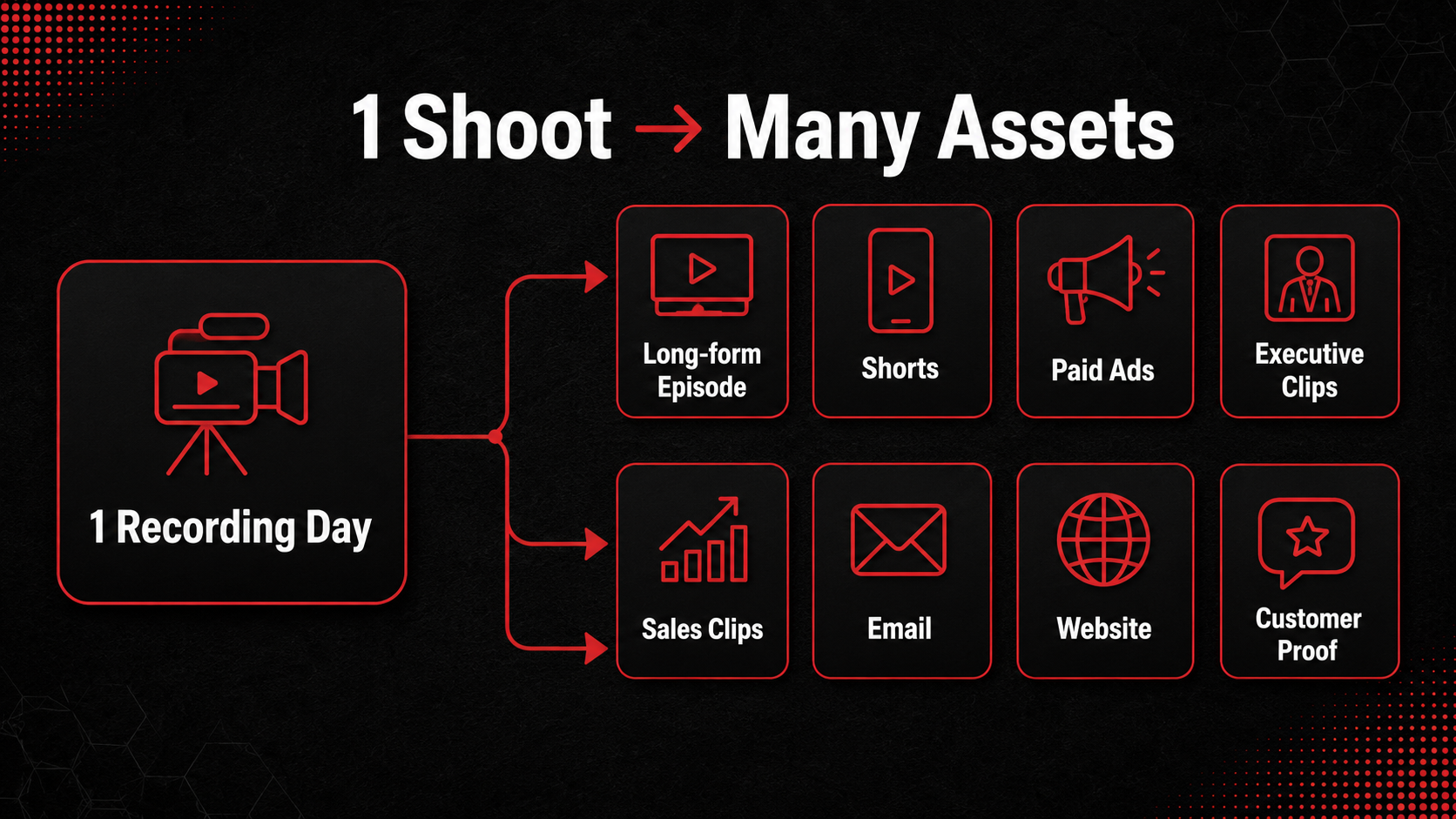
One source production can often support:
- long-form video
- YouTube episodes
- short-form social
- executive clips
- paid ads
- sales enablement
- customer proof
- website content
- ABM assets
That doesn’t mean every shoot should become 47 pieces of content for the sake of volume. It means the output should be planned around the strategy before production.
If you know a shoot needs to create content for YouTube, LinkedIn, paid media, and sales, you can capture the right material for each one.
A good video agency should help you make those decisions early.
7. Your team knows video matters, but you don’t have all the expertise in-house
An internal video team can work really well.
The important question is whether the team actually covers the full system.
Because “video person” can become a pretty wild job description.
One person may be expected to be:
- strategist
- producer
- camera operator
- editor
- motion designer
- copywriter
- thumbnail designer
- YouTube expert
- social strategist
- media buyer
- analyst
That’s a lot. Even very talented people have limits.
An agency gives you breadth without building every role internally
A B2B video agency can give you access to specialized expertise across:
- strategy
- research
- creative
- production
- editing
- distribution
- paid media
- reporting
- optimization
Without asking you to hire and manage four to six different specialists. That’s one of the biggest reasons even companies with internal video teams still use agencies.
They may already have:
- a studio
- videographers
- an editor
- internal marketers
but need deeper support around:
- strategy
- growth
- YouTube
- distribution
- paid media
- reporting
In-house and agency support don’t have to be mutually exclusive. A hybrid model can work extremely well.
8. You want to move faster without building the entire team yourself
Building the full capability internally takes time.
You have to:
- hire
- onboard
- create processes
- choose tools
- build workflows
- develop production systems
- establish reporting
- figure out distribution
- learn what performs
An experienced agency already has much of that infrastructure.
That can help a marketing team:
- produce faster
- reduce workflow bottlenecks
- test more creative
- support campaigns sooner
- keep content moving
- avoid reinventing every process
- access specialized expertise quickly
The value here isn’t outsourcing because your internal team can’t do good work.
It’s speed and leverage.
Sometimes rebuilding an entire specialized function internally simply isn’t the most efficient way to get where you’re trying to go.
9. You’re ready to treat video like a serious marketing channel
The best time to hire a B2B video agency is when your company is ready to actually commit to making video work.
That means:
- leadership sees video as strategically important
- the marketing team wants measurable performance
- people are willing to participate in strategy
- stakeholders will make time for production
- the company will actually distribute the content
- there’s enough budget to support professional work
- the team is willing to learn and optimize over time
You don’t need to have every answer before hiring the agency. In fact, strategy is part of what a good agency should help you figure out. But you do need to care.
Give the strategy enough time to work
For ongoing Sweet Fish programs, we generally look for teams that are willing to commit at least six months.
That doesn’t mean every video takes six months to produce results.
It means a real video system needs enough time to:
- build the strategy
- create the content
- distribute it
- gather performance data
- learn what works
- optimize
- repeat
Audience growth, thought leadership, organic discovery, and repeatable performance tend to improve as the team learns.
If you’re only willing to try video for three weeks and then move on to the next tactic, an ongoing agency partnership probably isn’t the best fit.
When an in-house video team may be enough
You may not need a B2B video agency.
If your internal team already has:
- strong video strategy
- audience research
- content planning
- production
- editing
- channel expertise
- distribution
- paid media support
- reporting
- ongoing optimization
and the system is working, keep doing it.
If your content is:
- consistent
- strategically sound
- getting produced quickly
- reaching the right audience
- generating the performance you want
- improving over time
then an agency may not add much.
The agency becomes more valuable when one or more of those areas is missing, overloaded, or slowing the rest of the system down.
When you may not be ready for an ongoing video agency
A premium ongoing video relationship is a meaningful marketing investment. It also requires some participation from the internal team.
You may not be ready yet if:
- video isn’t actually a priority
- there isn’t enough budget to support the scope
- nobody can participate in strategy
- nobody can make time for production
- the company isn’t willing to distribute what gets created
- you want immediate results without giving the system time to learn
- you only need a very small isolated deliverable
That doesn’t mean video isn’t useful for your business. It may just mean an ongoing agency partnership isn’t the right model right now.
What about one-off video projects?
One-off agency work makes sense too.
You may need:
- event capture
- one customer story
- a launch video
- a batch of ads
- editing support
- one specific campaign
That’s a different buying decision from hiring a long-term video partner.
This guide is primarily about the point where a company wants video to become an ongoing marketing capability.
The hidden cost of doing video in-house without the full system
The cost of internal video isn’t just equipment or headcount. It’s also what happens when the process doesn’t work.
That can mean:
- expensive footage never gets used
- campaigns launch late
- executives spend time recording content that never gets published
- creative becomes outdated
- paid media budgets go unused
- editing backlogs grow
- distribution gets skipped
- the brand looks inconsistent
- good ideas disappear in the workflow
That’s where “we’ll just do it ourselves” can become expensive without looking expensive on a spreadsheet.
You already paid for the production. You already spent the time. You just didn’t get the business value from it.
Do you need a B2B video agency? A quick decision checklist
You’re probably ready for a video agency if:
- video is becoming an important part of your marketing strategy
- your output is inconsistent
- your team is overloaded
- footage keeps piling up
- you don’t have a clear video strategy
- your videos aren’t performing
- distribution is weak
- you need multiple formats from each production
- you want faster turnaround
- you need specialized expertise you don’t have internally
- you want a repeatable video system
- you’re prepared to commit to the strategy
- you want measurable audience growth, performance, or ROI from video
You may be fine in-house if:
- your strategy is strong
- production is consistent
- editing moves quickly
- distribution is already covered
- performance is strong
- you have enough internal bandwidth
- the system keeps improving
You may not be ready for an ongoing agency yet if:
- video isn’t a real priority
- you can’t support the investment
- nobody can participate in strategy or production
- the organization won’t distribute the content
- you only need a very small one-off deliverable
What should a B2B video agency actually do?
A full-service B2B video agency may support the entire system:
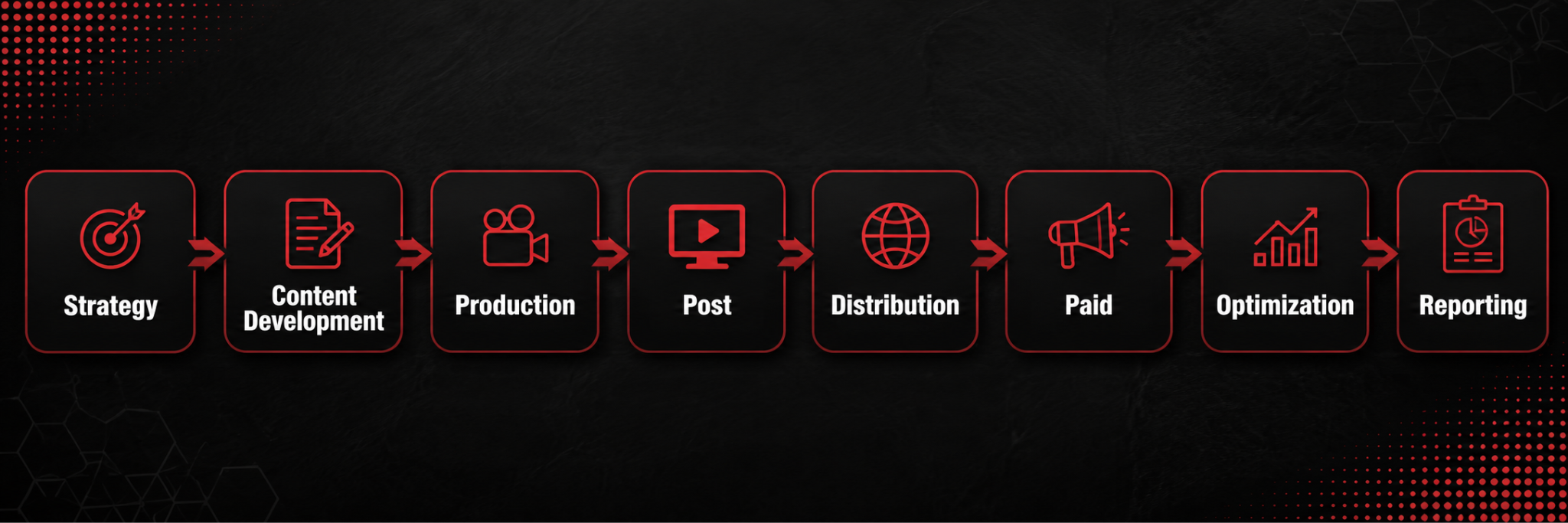
Strategy → Content Development → Production → Post-Production → Distribution → Optimization → Reporting
That can include everything from audience research and content planning to filming, editing, YouTube, paid media, and performance analysis.
We break that process down in more detail in our guide to [The Sweet Fish Video System].
If you’re evaluating podcast-specific support, you can also read our guide to what video podcast production services should include.
How much should you expect to invest?
Professional B2B video is usually a meaningful marketing investment because you may be paying for much more than a finished video.
The scope may include:
- strategy
- production
- editing
- distribution
- paid media
- performance support
A lower-cost production partner may be a perfectly good fit if you already have most of that expertise in-house.
If you need the full system, compare the scope and capabilities carefully rather than looking only at the monthly number.
For a more detailed look at professional podcast and video show pricing, read our guide to video podcast production costs.
What Sweet Fish looks for in an ongoing video partnership
Sweet Fish works with companies ranging from small B2B teams to global enterprise brands.
The biggest prerequisite isn’t company size. It’s commitment.
We work best with teams that:
- take video seriously
- want video to perform
- are willing to collaborate
- will participate in strategy
- can make time for focused production
- are prepared to support an ongoing program
- want to learn and improve over time
You don’t need a studio. You don’t need a huge internal team. You don’t need a giant backlog of content ideas. That’s part of what we can help with.
And the time commitment doesn’t need to take over your calendar.
For many programs, we can capture a quarter’s worth of source content in one or two production days, then handle the bulk of the strategy, production, post-production, distribution, optimization, and reporting around it.
If you want to see how that works, read about The Sweet Fish Video System.
Frequently asked questions about hiring a B2B video agency
When should a company hire a B2B video agency?
A company should consider hiring a B2B video agency when video is becoming an important marketing channel but the internal team lacks the strategy, bandwidth, production consistency, editing capacity, distribution capabilities, or performance expertise needed to make it work at scale.
What are the signs that a company needs a video agency?
Common signs include inconsistent video output, footage piling up, slow editing, weak distribution, poor or inconsistent performance, unclear strategy, limited internal expertise, and difficulty turning one production into multiple useful marketing assets.
Is it better to hire a video agency or build an in-house team?
Either model can work. An in-house team can be a great option when the company can support video strategy, production, editing, distribution, paid media, reporting, and optimization internally. An agency can provide broader specialized expertise and speed without requiring the company to hire and manage every capability itself.
What does a B2B video agency do?
A full-service B2B video agency can support strategy, audience research, content development, professional production, editing, design, YouTube, social video, distribution, paid media, analytics, reporting, and ongoing optimization.
How long should you work with a video agency?
The right engagement length depends on the goals and type of work. For ongoing video programs focused on audience growth, thought leadership, content systems, or organic performance, companies should generally allow enough time to implement the strategy, gather performance data, optimize, and repeat. Sweet Fish typically looks for at least a six-month commitment for ongoing programs.
Can a video agency help with strategy?
Yes. A strong B2B video agency should be able to help connect video to business goals, audience needs, content demand, funnel stages, channels, formats, distribution, and performance metrics rather than focusing only on filming and editing.
Should a B2B video agency handle distribution?
For a full-service engagement, distribution should be part of the strategy. That may include YouTube, LinkedIn, short-form social, email, websites, sales enablement, ABM, paid media, or other channels where the target audience is likely to see and use the content.
Can a video agency manage paid media too?
Some full-service B2B video agencies also support paid media. This may include YouTube, LinkedIn, Meta, retargeting, subscriber growth campaigns, or conversion-focused video advertising. Paid media can be especially useful when a company wants more control over who sees the content and how quickly it reaches the target audience.
What if we already have an internal videographer?
You may still benefit from an agency. Many companies have internal production capabilities but use an external partner for strategy, content development, editing capacity, distribution, YouTube expertise, paid media, analytics, or optimization. A hybrid model can work well when the internal and external teams have clearly defined roles.
Do you need a studio before hiring a video agency?
No. A video agency can often provide the crew, equipment, set design, and production environment needed. Depending on the project, filming may happen in an agency studio, client office, existing company studio, event, customer location, or another production environment.
Is hiring a B2B video agency worth it?
Hiring a B2B video agency can be worth the investment when video is strategically important and the agency fills capabilities the company doesn’t have internally. The value usually comes from creating a more consistent, faster, better-distributed, and more measurable video system rather than simply producing individual videos.
How much does a B2B video agency cost?
B2B video agency pricing varies widely based on strategy, production complexity, filming frequency, number of deliverables, distribution, paid media, and ongoing support. Production-only services may cost much less than full-service engagements that include strategy, content development, distribution, reporting, and optimization.
Hire an agency when video deserves a real system
You don’t need a video agency just because video appears somewhere on your marketing plan.
But once video becomes important enough that strategy, consistency, speed, distribution, performance, and growth matter, the system gets complicated pretty quickly.
At that point, you have two options.
Build every capability internally.
Or bring in a partner that already knows how to connect the pieces.
If your team is ready to take video seriously but doesn’t want to build the entire function from scratch, that’s usually where a strong B2B video agency becomes valuable.
If that sounds like where your team is now, book a call with Sweet Fish Media.